Growth beneath the surface: The real story behind SME credit trends
UK SME credit demand strengthened in Q4 2025, with applications and new lending volumes rising even as economic uncertainty, cost pressures and affordability challenges persist. Growth is being driven by lower‑value and working capital products, while higher‑value investment lending has slowed and risk profiles are beginning to shift.
The UK SME Credit Trends Index reveals where lending momentum is building, where vulnerabilities are emerging, and what macroeconomic and policy changes mean for 2026.
Download the report to get the insight lenders need to balance growth, risk and responsible lending in a changing SME market.
In this report, we cover:
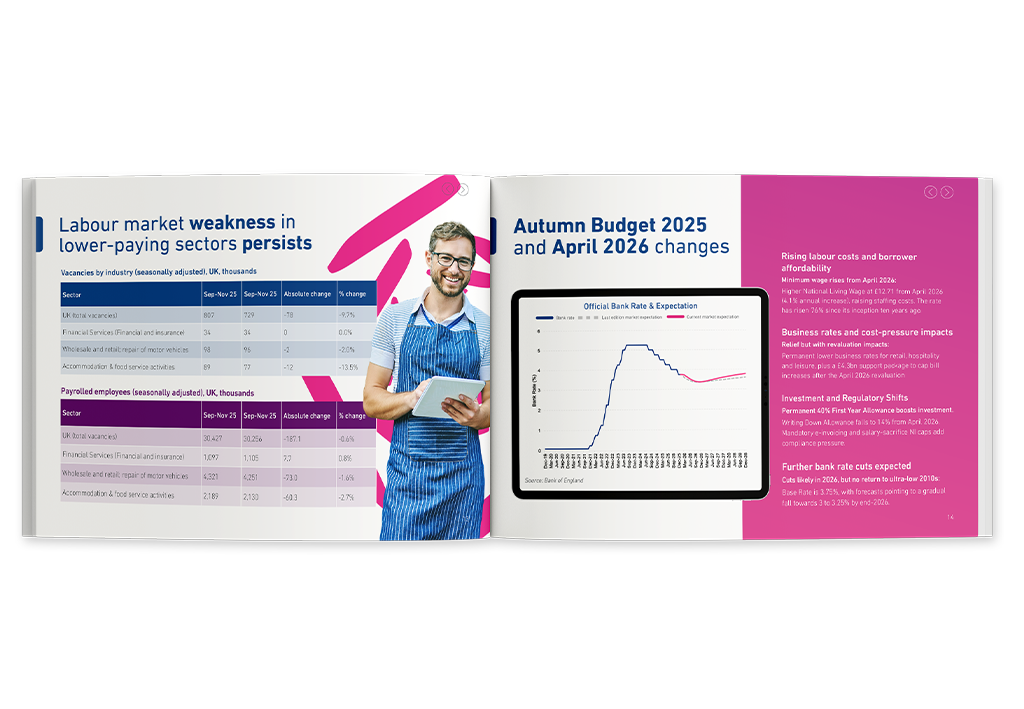
SME credit trends to watch
We look at demand and supply, the role of alternative lenders, and credit performance highlights.
Macroeconomic outlook
How economic trends are shaping SME resilience.
SME demands
How demand for credit is reflected into lending and SME delinquency rates.
A sneak peek into...
Experian UK Small and Medium-Sized Enterprise (SME) Credit Trends Index

Mark England, Head of Commercial Insight, Data Office, Experian
Foreword
The latest UK SME Credit Trends Index presents a picture of resilience set against a fragile and shifting economic backdrop.
Headline inflation has eased from its peak, but remains sufficiently embedded, particularly in services, to constrain real wage growth and suppress broader confidence. With GDP growth expected to remain modest and risks tilted to the downside in 2026, SMEs are operating in an environment shaped by elevated input costs, tax and wage policy changes, and continued geopolitical and financial market volatility.
Despite these headwinds, credit demand has strengthened. SME applications returned to growth in Q3 and accelerated into Q4, with searches up 6% quarter-on-quarter and 21% year-on-year. This recovery in demand has translated into rising new lending volumes,
up 19% year-on-year, with growth particularly concentrated in lower-value and working capital products. Asset finance and cards have been especially robust, while mortgage lending has remained strong.
Did you enjoy the read?
Download the full report
To find out more about identifying SME Credit Trends, download our report.

Further reading

Monthly Credit Index Report: March 2026
How are businesses adapting to the ever-evolving credit risk landscape in the UK? Our latest report dives into Experian's view on the current trends and helps you make better commercial lending decisions.

Explore the UK’s Commercial Lending Landscape
Our interactive map offers a taste of the type of insight Experian can provide across the United Kingdom's commercial lending ecosystem.

Financed emissions: Closing the SME carbon data gap
To meet their climate goals, lenders need accurate emissions data from business customers. Here, we outline creative strategies to reduce financed emissions.

Three methodologies for assessing commercial affordability
Assessing commercial affordability can be a complex task. In this blog, we will discuss three key ways to assess commercial affordability.

What do SMEs need to know about AI in 2026?
Learn what SMEs need to know about AI in 2026, from practical use cases and productivity gains to governance, data quality, and adopting AI safely and effectively.

Fraud Index Report: Q4 2025
How has fraud changed over the past year? Read the latest fraud statistics and trends in Experian's Fraud Index Report for Q4 2025.

How reliable vehicle verification can boost your business
As an automotive retailer, how can you find out the true history of a vehicle? Or are you unsure if you're overpaying for a vehicle? See how data can help.

How Open Banking is reshaping mortgage lending at Leeds Building Society
We aim to help lenders drive automation, speed up decisions, and support financial inclusion in mortgage lending, giving consumers more control and support.

UK Fraud and FinCrime Report 2025
From AI scams to identity fraud - see what’s driving UK financial crime in 2025 in our latest report, and find out how to respond with confidence.
Open Banking Data: The Ultimate Guide for Business