
Blog
How UK businesses are paying for sales and marketing data problems they don’t know they have
How gaps between confidence in data quality and the reality are undermining B2B sales and marketing performance, and what to do about it.

14 October 2026
read
Summary
- More than nine in ten sales and marketing decision makers we surveyed are confident in the quality of their external business data, yet almost all have experienced a commercial consequence from poor quality data in the last year.
- More than nine in ten are confident that data is fully GDPR compliant, yet one in three experienced a compliance incident in the same period.
- When UK businesses select external data providers, compliance and sourcing practices rank seventh out of nine selection criteria.
- Closing these gaps does not take a longer process, it takes asking a provider the right questions before something goes wrong.
Data quality is rarely the first thing sales and marketing leaders point to when a campaign underperforms or a quarter falls short. Targeting, creative, timing and budget are more visible, so they get examined first. The quality of the external business data underneath all of them can matter more than many businesses realise.
We commissioned independent research among 250 senior decision makers with direct responsibility for sales or marketing activity across UK B2B businesses, to find out how confident they are in their data and whether that confidence is justified. The findings point to a gap between how businesses feel about their external business data and what it is delivering.
That gap shows up in three places: in confidence, in how providers are chosen and reviewed, and in compliance. In each case the fix is more straightforward than most organisations expect.
The Confidence Gap
Confidence in the accuracy and reliability of external business data is high. More than nine in ten respondents (93%) described themselves as confident in the quality of the external business data their organisation uses for sales and marketing, with 57% very confident and fewer than one in ten (6%) expressing any reservations.
Asked whether they had experienced problems in the last twelve months as a result of poor quality business data, almost all of the same respondents (95%) reported at least one commercial consequence:
- close to four in ten (39%) had wasted budget trying to reach contacts who had moved on or companies whose details were no longer correct
- a third (34%) had lost significant time correcting and cleaning data before they could use it
- a third (33%) had faced a compliance issue or risk
- three in ten (30%) had seen a campaign significantly underperform
- almost a quarter (23%) had damaged a relationship with a client or prospect
- close to one in five (19%) had lost a deal or opportunity they should not have lost.
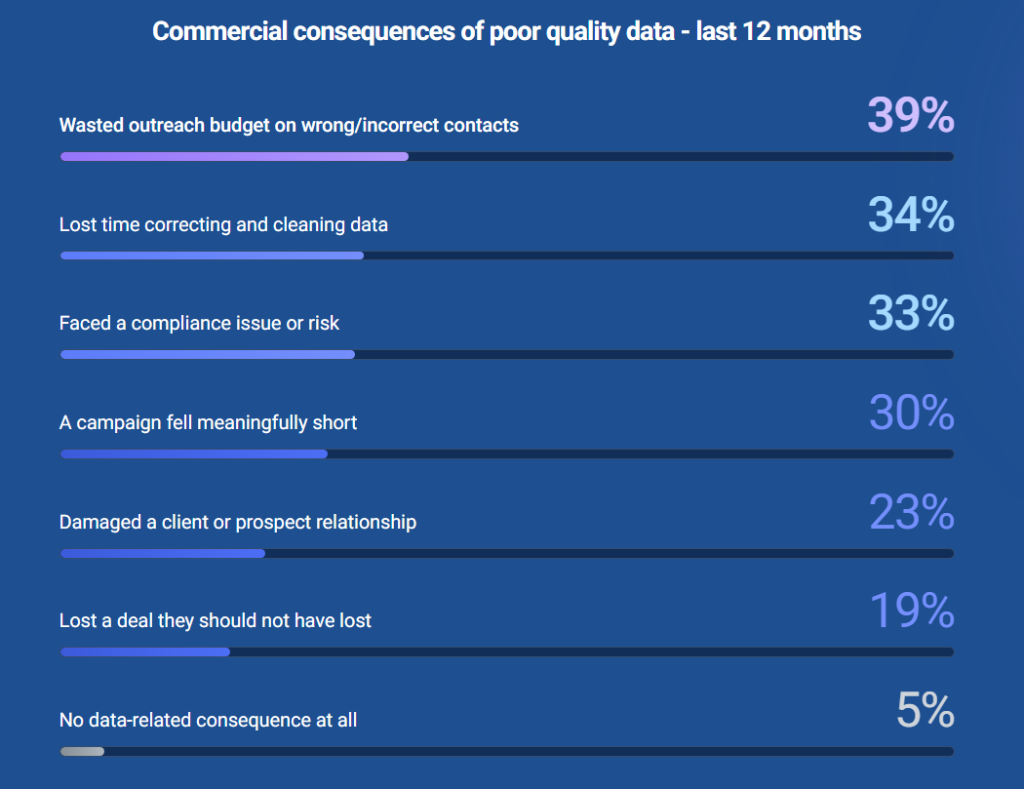
The director-level picture shows the contrast most sharply. Every director surveyed said they were confident in their external business data, yet six in ten (60%) had wasted budget on wrong or outdated contacts, the highest rate of any seniority group.
Consequences like these rarely arrive labelled as a data problem. They can look like a disappointing campaign, a slow quarter, or a client conversation that did not go as expected, which is part of why the gap persists and why it becomes addressable as soon as you know where to look.
What to do

Ask your team how much time they spend each week correcting and managing data rather than using it. Across our research the average was 4.24 hours a week, more than 220 hours a year, and most teams have never measured it.

Take a campaign that underperformed last quarter and check the data it ran on before you look at anything else.

Ask your provider for evidence rather than assurance: how often records are refreshed, and what happens to the ones that go stale.
The Data Decision Gap
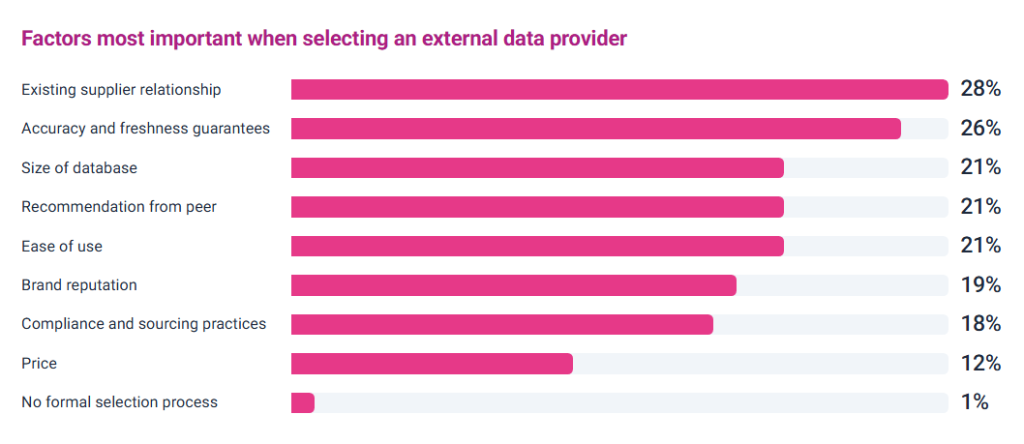
More than nine in ten respondents (92%) have a formal or semi-formal process for selecting their external data providers, including more than half (55%) with a structured evaluation process in place. The question is what those processes prioritise.
Asked to identify their top two selection criteria from a list of nine options, respondents put existing supplier relationships first, cited by more than a quarter (28%). Compliance and sourcing practices ranked seventh, cited by fewer than one in five (18%).
How a provider meets compliance standards is difficult to assess after the fact, and it affects whether the data can be used as intended. A selection process that ranks it below ease of use may not be testing the criterion most likely to cause harm.
The same pattern shows up after selection. The majority of businesses (61%) review their external data providers at least quarterly, which sounds encouraging. Across the whole sample, though, one in three (33%) still faced a compliance issue or risk in the same twelve months.
How often providers are reviewed may matter less than what those reviews test.
What to do

Add two questions to your next provider review: where does this data come from, and how do you prove it is current?

Move compliance and sourcing practices into your top selection criteria rather than treating them as a lesser factor.

Ask for accuracy and freshness guarantees in writing, with a remedy if they are missed.

Review the data separately from the relationship. Good account management is not always evidence of good quality data.
The Compliance Illusion
Confidence in the GDPR compliance of external business data is high too. Asked about it directly, more than nine in ten respondents (93%) described themselves as confident that the external business data they use for sales and marketing meets UK data protection requirements, with more than half (56%) very confident and fewer than one in ten (7%) expressing doubts. The same one in three (33%) who reported a compliance issue earlier in this research attributed it directly to poor quality data, which suggests that confidence is not always borne out.
The research also found a divergence by seniority. Every director surveyed said they were confident in the GDPR compliance of their organisation’s data. Among senior managers, who are more likely to work with that data day to day, more than one in ten (12.3%) had doubts about its compliance status. The people with the most direct experience of how the data performs hold a different view from those making the purchasing decisions.
That difference matters more as AI becomes embedded in sales and marketing workflows. With 94% of respondents already using AI-powered tools, 97% told us their data is sufficient to produce reliable AI outputs. AI does not verify the data it processes; it acts on it, at scale and at speed. Where the people closest to the data already have doubts, an automated system can carry those doubts further and faster.
Key takeaway
Many businesses have not looked closely at how their providers source data, which can leave them exposed to compliance incidents, reputational damage and the commercial consequences that follow. Asking the right questions before something goes wrong is one of the most straightforward things a sales or marketing leader can do to reduce that exposure.
What to do

Ask your provider to show you how the data they supply meets compliance standards, and where it came from, in writing.

Check whether your senior managers share the same confidence in data compliance as those who procure it. Our research suggests some do not.

Find out what happens to a record when permission changes, and how quickly that reaches your systems.

Before your next AI rollout, verify the external business data feeding it rather than assuming it is fit for purpose. AI is likely to move faster than your review cycle.
What this means in practice
Across the research the pattern is consistent. UK sales and marketing teams are not ignoring data quality. They are managing it through processes that were not designed to surface the problems most likely to cause commercial and compliance harm: provider selection weighted towards relationships, compliance assumed rather than verified, and review cycles that test service levels more closely than sourcing standards.
Addressing that does not take a larger process. It takes one pointed at the right things:
- ask a provider what they can prove, rather than how long you have worked with them
- move compliance and sourcing into your top selection criteria
- check whether the people closest to your external business data share the same confidence as those who procure it
- before scaling AI investment, verify the data it will be built on.
The external business data behind your sales and marketing shapes who you reach, what your campaigns deliver, how your CRM performs and, increasingly, how your AI tools behave. For most organisations it goes unexamined until something goes wrong. Asking the right questions earlier can change that.
How Experian can help
Business Prospect Profile (BPP) is a fully GDPR compliant AI-powered B2B targeting platform. It helps you find the right companies and the right people inside them.
With Business Prospect Profile, you can achieve:
- 80% faster list-building
- more accurate outreach
- lower campaign cost per lead
- cleaner CRM for better segmentation
- shorter time to market for outbound campaigns.
Find out more
Methodology
The research was conducted by Censuswide, among a sample of 250 25+ senior business decision makers (manager level or above) within B2B organisations in the UK. The data was collected between 16.07.2026 and 28.07.2026. Censuswide is a member of the Market Research Society (MRS) and the British Polling Council (BPC), and a signatory of the Global Data Quality Pledge. We adhere to the MRS Code of Conduct and ESOMAR principles. Questions on provider selection, evaluation and review were asked only of respondents who use external business data (base 247).