
Written by

Published Jun 2026
Summary
- Generic B2B data lists are no longer effective. Poor quality and lack of relevance lead to wasted spend, low engagement, and missed opportunities.
- Modern prospecting relies on insight-driven data, combining contact details with behavioural signals, intent data, and contextual insights for more precise targeting.
- Data list quality varies widely: traditional lists lack depth, enriched lists add context, but insight-led lists deliver the strongest conversion potential.
- A strong strategy starts with cleansing existing data, then prioritising high-quality, relevant prospects over large volumes of cold leads.
Why buying data lists no longer works
B2B prospecting is essential for business growth. A steady flow of new opportunities keeps the pipeline moving and supports long term revenue.
At the heart of prospecting and lead generation is data. But not all data lists are created equal. When we say data lists do not work, we mean generic, low quality lists.
Businesses are already bombarded with emails, calls and LinkedIn messages built around generic sales pitches. Buying poor quality B2B prospect lists only adds to that noise, leading to irrelevant communications, low engagement and poor return on investment.
Many generic lists also lack quality assurance, meaning the data may be inaccurate, incomplete or out of date, with little evidence of recent cleansing or compliance checks.
Instead of chasing large marketing lists, the focus should be on pairing high quality data with actionable insights. Lists only work when they enable the precision and personalisation customers expect.
Limitations of generic B2B data lists
Generic marketing data lists can mean running into one or more of these issues:
Outdated or incorrect data
B2B data can change rapidly, from sudden budget shifts and changing business priorities to changes to decision-makers, which means your comms land in front of the wrong people.
Irrelevant information
Without robust quality control, you could be paying for a massive amount of data that has little relevance to the wants and needs of your target audience.
Crowded inboxes and feeds
Both inbound and outbound spaces are busy, meaning it’s easy to fade into the background with generic, untargeted campaigns.
Meaningless communication
If you don’t truly know your customer and their wants, needs, and pain points, your campaigns are unlikely to spark meaningful sales conversations.
Key takeaway
B2B data lists do have their place… but you need to be strict and selective with how you choose them. Combining first- and third-party information with valuable analytics and the right technology can create a powerful data-led sales strategy.
What is B2B prospecting?
B2B prospecting means to identify and engage with the right potential customers in order to build awareness, drive conversion, and ultimately increase sales opportunities.
This process starts with a data list, which is essentially a list of people or companies who are most likely to turn into customers. It will include details such as company names, plus the roles and contact information for important decision makers within the organisation.
This list is then given to marketing and sales teams to craft effective campaigns or outreach strategies. And because revenue generation and growth both start with a data list, many businesses see this, and the process of prospecting, as an essential business function and top priority.
However, data lead lists aren’t a one-size-fits-all fix and they can wildly vary in quality. Plus, without meaningful and actionable insights they can often be nothing more than data dumps. So, to ensure your money and time is worth investing, it’s important to do your homework on not only the data you’re purchasing but the company you’re acquiring it from.
Types of B2B data lists
| What is it? | What does it include? | Is it worth your time? | |
| Traditional data lists | Foundational contact lists built with basic business information and third-party data. |
| We wouldn’t go there. These data lists can be useful for startups and SMEs looking to build a quick client list, but ultimately they lack the contextual insights needed to build effective targeting campaigns. |
| Enriched data lists | Basic contact lists enhanced with context and useful information to encourage precise targeting. |
| They can be. If the data list has genuinely useful and relevant enrichments, you’re moving in the right direction toward driving higher conversions. |
| Insight-driven data lists | Comprehensive contact lists enhanced with first-party data to provide highly relevant and specific targeting information. |
| Absolutely. These data lists are packed with valuable, personalised insights, helping you create highly effective marketing campaigns that drive real sales. |
Where to find B2B marketing prospects
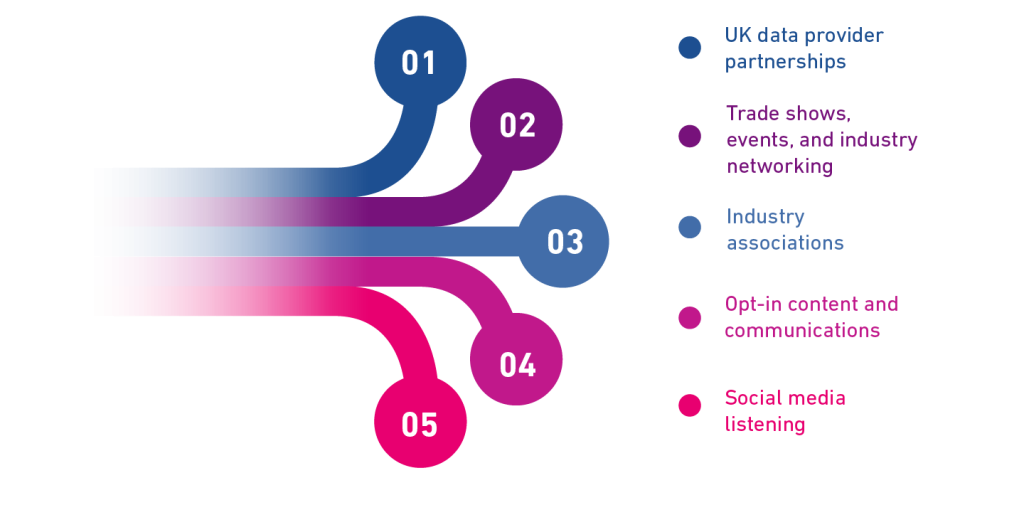
1. UK data provider partnerships
These services specialise in supplying UK-centric data and may provide specific or niche information that aligns with your business and industry. However, quality and accuracy can fluctuate, so it’s important to do your research on the providers before joining forces with a strategic business data partner.
We are a trusted provider of B2B data in the UK. We combine large scale data aggregation with strict regulatory compliance, rigorous multi-source validation, and financial-grade risk insights.
2. Trade shows, events, and industry networking
Industry tradeshows and events can be great places for teams to collect and exchange contact information. Here, you’ll get complete control over building your list plus, these interactions mean the leads are already warm.
3. Industry associations
Joining and collaborating with industry associations and trade groups can give you access to highly relevant, sector-specific B2B data lists. However, relying solely on these can limit your future growth, particularly if your industry is small.
4. Opt-in content and communications
You can often acquire B2B data by offering exclusive content or specialised resources in exchange for contact details. This can be a really handy way to keep prospects engaged, but consistently creating high-quality content can be resource-intensive.
5. Social media listening
Monitoring trends, conversations, mentions, and interactions across social media (both your own, competitors, and industry-specific) can be a great way of acquiring leads. However, this is another resource-intensive activity and doesn’t always lead to quality prospects.
Key takeaway
There are many different ways to build a B2B data list depending on your company’s size, budget, and objectives. Defining clear goals at this stage can help you source the most valuable information and insights down the line.
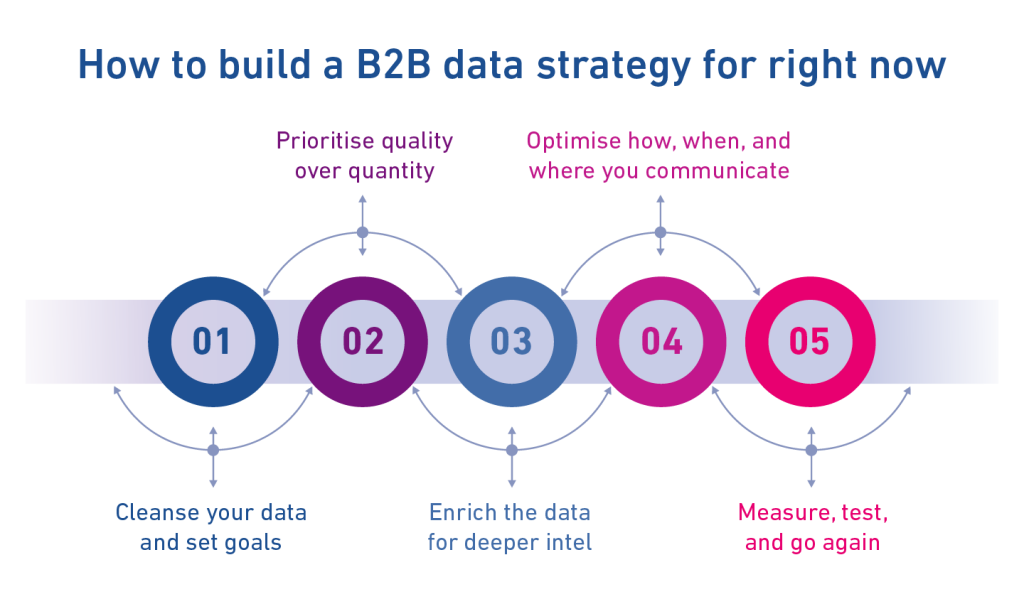
How to build a B2B data strategy for right now
It’s clear: buying generic data lists = bad, crafting insight-driven, future-proof data lists = good.
But how, exactly, do you acquire more insightful data to create genuinely personalised campaigns that drive measurable ROI?
It starts by stopping blanket outreach and combining high-quality, cleansed data with strategic insights. From here, you can then set effective targeted campaigns into motion, which maximise engagement and response rates, while minimising wasted marketing and sales resource.
1. Cleanse your data and set goals
Before diving into new data collection, it’s best to first clean up what you already have so you can ensure GDPR-compliance, eliminate dead ends, and maximise the effectiveness of what you’re already working with. A newly cleansed data set can also give you clarity on marketing and sales objectives, so you can define what success truly looks like.
2. Prioritise quality over quantity
A long list of cold, generic leads will only waste budget. Concentrate your efforts on finding highly qualified lists that can be integrated with your existing data, match your ideal customer profile, and contribute to the objectives from step 1. Examples of deeper insights include company growth signals and purchase-intent data.
3. Enrich the data for deeper intel
Combine both first- and third-party data with external insights and analytical enrichments to give a comprehensive understanding of your prospects. It really is as simple as: the more you know, the better you can target.
4. Optimise how, when, and where you communicate
With a rich data list in hand, you can now tailor the channels, messaging, and automation tools you use. Start by identifying the most effective channel so you can meet your audiences where they actually are. Then, craft messaging that truly speaks to them. You can use test-and-learn methods to refine the creative. Finally, implement AI-powered automation tools to streamline your initial outreach and manage subsequent follow-ups.
5. Measure, test, and go again
Lead generation and B2B prospecting isn’t a one-time project. It’s an ongoing evolution that requires continuous monitoring of elements like response and conversion rates. Analytical tools can also help you spot any friction points and optimise your campaigns for even better returns.
Key takeaway
Ditch the generic one-size-fits-all marketing approach and use your newly acquired data insights to craft personalised, relevant campaigns that can be measured and optimised.
We can help
With 30 years of UK data expertise, we know data. Using high-quality and insight-led analytics, our data intelligence and experience helps you stop the guesswork that can come from using generic data lists, and instead focus on growth and ROI.
With us, you’ll get:
- access to over 15 million confirmed contacts across 4.9 million active companies
- total market visibility, including over 900k sole traders not found on Companies House
- seamless integration with your CRM systems, including Hubspot and Salesforce
- data validated by robust verification methods for total reliability and accuracy
- full GDPR and SOC2 compliance for complete peace of mind.
Find out more
See how our Verified B2B Data & Marketing Lists can help your business, and speak to our expert team for more. Alternatively, explore our self-service data tool, with AI-powered search for premium data and smarter campaign creation.