

Why does data munging matter?
Data can be messy – particularly raw data in large volumes. Incomplete, inconsistent, duplicated, or unstructured… the list of data quality issues goes on, and the impact of using this unstructured or disordered data can be far-reaching across any business.
By transforming this messy data into something coherent and structured, you make it easier to use and gain insights from. In fact, that’s the overall goal of munging: to provide high quality and useful data that can facilitate better decision making, increase efficiency, power your AI projects, and improve data governance and compliance.
What is data munging?
Data munging – sometimes called data wrangling or data preparation – is the process of taking data from its ‘raw’ state and transforming it into a usable format.
Think of data munging as the bridge between data collection and data analysis. Through data cleaning, structuring and standardisation, it turns messy information into meaningful datasets and more useful and usable formats. It’s a vital step to take ahead of activities such as:
- Standardising
- Data cleansing
- Data matching
- Filtering
- Data governance and conformity
- Data consolidation and integration
- Building training data for AI
The end result provides more accuracy and precision, more meaningful insights, and better business decision making.
Benefits of data munging
Improved accuracy and reliability
Data munging ensures your data is free from errors, duplication, or any missing values. All in all, it leads to improved data integrity, which is of course the backbone to everything from improved business performance to strengthened customer insights.
Increased operational efficiency
By reducing the time and resource needed for manual checks and corrections, munging can streamline your data processes. More than this, teams can get to work doing more valuable tasks such as data analysis than data preparation.
Better, faster decision making
Your teams will be able to view and analyse clean, structured data in a quicker way than having to unpick through messy and incomplete information. In turn, this will lead to quicker insights and reporting which can then be delivered to the wider business and stakeholders for decision making.
Adherence to data compliance
By having your data organised, you can better identify sensitive information and more easily spot where there could be compliance issues. More than this, munging makes it easier to track data lineage and changes to your data in order to maintain audit trails.
Data munging in action
A common example that shows how data can arrive in your database damaged or incomplete is through email address input. To avoid spam, users may purposefully damage the valid format of their email address by sharing it in a way only humans can decipher.
A machine is unlikely to be able to interpret something like…
JohnDOTdoeATJohnDoeDOTcom or John(dot)doe(at)John(dot)doe(dot)com
…and so that data will sit in your system as an incoherent piece of information, unable to be considered or used within datasets.
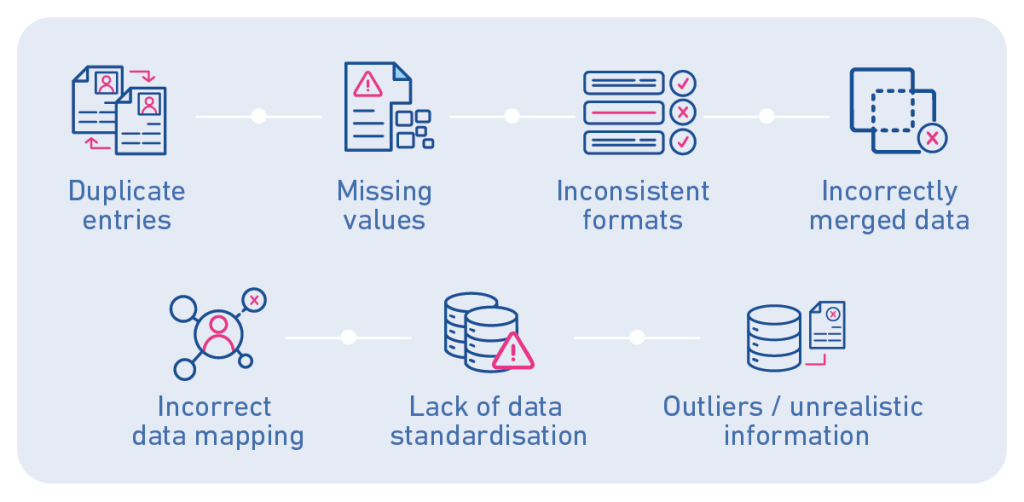
Other examples of errors can include:
- duplicate entries
- missing values
- inconsistent formats
- incorrectly merged data
- incorrect data mapping
- lack of data standardisation
- outliers / unrealistic information.
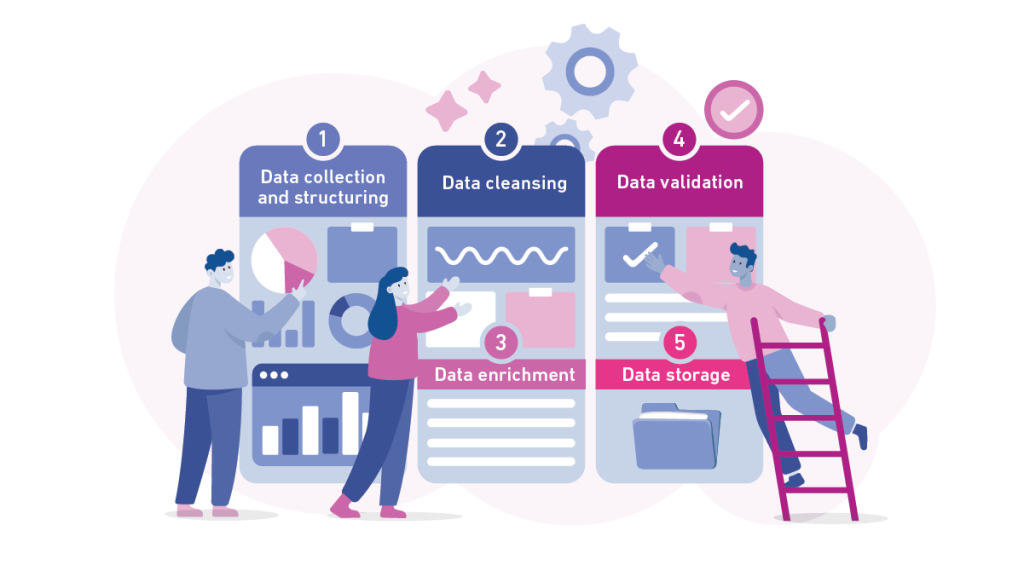
How the data munging process works
1. Data collection and structuring
This first step will give you a solid foundation on which to base your entire data munging work from. Start by understanding what data you have available and whether it’s necessary for your chosen project. Data is likely to be located in sources such as databases, spreadsheets, customer relationship management systems, or APIs. Once it has been gathered, you can format it into more organised repositories for easier storage and retrieval.
2. Data cleansing
Cleaning up your data is fundamental to the success of a data munging project. After all, how can you properly transform the information if there are significant errors or inaccuracies within it? Use this step to remove duplicate data, handle missing data, correct inconsistencies, and apply standardisation/normalisation.
3. Data enrichment
You can now think about enriching this neatly ordered dataset with even more valuable insights. By enhancing data with relevant information from a range of external sources, such as customer demographics or performance metrics, you can create a more comprehensive and valuable asset.
4. Data validation
Now’s the time to check the accuracy and consistency of all your hard work. Measure the new datasets against your internal data quality standards and any GDPR obligations. As well as ensuring compliance, this step will confirm that your data is robust, high quality, and ready for analysis.
5. Data storage
Your freshly cleansed and munged dataset now needs to be housed. When it comes to selecting a storage option, consider the data’s format and whether it can be easily accessed for future use and analysis.
How can we help?
Data munging / wrangling is a critical step for most data processes, as it ensures your data is appropriately cleansed and structured. Consider it you getting your data ducks in a row ahead of any analysis or model building. Then, with this neat, clean, and tidy data you can better spot advanced analytics, drive more informed decision making, and ensure data compliance.
We can help lay the foundation for success with data quality solutions that increase confidence in your enterprise data. Our range of data quality and analytics tools, including Aperture Governance Studio, helps you get your data in shape.