
Summary
- Consumer data drives confident decisions when guided by a clear strategy.
- Strong insight depends on high quality, complete data.
- Set clear goals and treat your data strategy as a continuous cycle.
- Use data to sharpen marketing, find new opportunities, and improve performance.
- In financial services, bureau and Open Banking data support fairer credit decisions.
- Transparent, responsible data use keeps customers and regulators confident.
Why does consumer data matter for your business?
Consumer data is one of the most powerful assets your organisation has.
When used strategically and responsibly, consumer data helps organisations understand people’s behaviours and needs. When these insights are paired with context, they support more relevant and fair products, services, and experiences. Over time, this strengthens customer value and loyalty. Data also helps you spot behavioural shifts driven by economic pressures, such as inflation, and be forward looking rather than relying only on historical trends.
Most organisations collect data but many struggle to turn raw information into something useful. A clear, objective led strategy will help you convert raw data into actionable insight, create measurable results, and generate a continuous, insight driven decision making loop.
What is consumer data?
Consumer data is the information an organisation collects about people through their interactions, behaviours, and choices. Each detail helps build a complete picture of who customers are, how they act, and what they need.
Key takeaway
Consumer data should give you confidence in any decision, but only when it’s guided by a clear strategy and transformed into actionable insights.
Consumer data benefits
Consumer data helps address a wide range of common business challenges:
| Business area | How consumer data helps |
| Commercial and credit decisions | Understand how customers borrow and manage credit; identify financial behaviours; improve eligibility and decisioning; and reduce risk while increasing acceptance rates. |
| Customer understanding and targeting | Identify target market and demographics; track behavioural changes; and align products with real customer needs. |
| Product design and strategy | Design fair and accessible products; match customers to the right products; and support innovation and inclusion by using non-traditional data sources. |
| Regulatory and societal challenges | Support financial inclusion; identify vulnerable or underserved consumers; and respond effectively to regulatory and policy changes. |
And for consumers…
Data insights aren’t just beneficial for businesses. When used responsibly, data helps organisations deliver more relevant, timely, and useful experiences to its consumers. This leads to improved products and services, stronger brand trust, and increased loyalty. Ultimately, the richer the insights, the more consumer-centric an offering can become.
Types of consumer data
Every single consumer detail and interaction is a piece of the puzzle that builds a complete picture of your customers. Once you understand what data you have available, you can start to use it strategically, developing a more comprehensive and detailed understanding of who your audience is and who it could become.
This data can be categorised as either first-, second-, or third-party data which, when combined, can create robust and highly targeted segmentation combinations.
Attitudinal data
Examples
Survey response
Website reviews
Brand feedback
Loyalty program selections
Behavioural data
Examples
Online activity
Purchase history
Brand interactions
Website browsing patterns
Demographic data
Examples
Age
Gender
Education
Occupation
Engagement data
Examples
Social media interactions
Website visits
App usage
Email open rates
Geographical data
Examples
Location
Cultural preference
Infrastructure available
Population type and density
Identity data
Examples
Name
Date of birth
National Insurance number
Customer IDs
Psychographic data
Examples
Activities and interests
Values and beliefs
Lifestyle choices
Opinions and attitudes
Transactional data
Examples
Purchase patterns
Basket or cart values
Payment methods
Location of spend
Consumer data for credit and financial services
For organisations in the credit and financial services sector, a recent major focus has been around financial inclusion; particularly in identifying individuals who lack access to affordable credit products and understanding the challenges and consequences they face as a result.
Over the last decade, credit bureau and Open Banking data has helped transform the credit market into a more consumer-friendly experience. It has played a vital role in addressing these issues, by providing rich data and deep insight to support policy development, regulatory compliance, and responsible product design. All in all, this can help organisations in the sector make more informed decisions and promote fairer, more inclusive access to credit.
The insights available from credit bureau and Open Banking data include:
- Understanding how people are borrowing
- Assessing non-traditional data to help those with thin or limited credit files
- Spotting changes in financial habits over time
- Assessing the differences across demographics and life stages
- Contextualising the impact of external factors, such as the cost of living crisis.
Key takeaway
For organisations working within financial services, credit bureau and Open Banking data helps facilitate fairer credit assessments and decisioning, which in turn leads to more choice and better outcomes for the consumer.
Importance of data quality
To reap the rewards that consumer data can bring, organisations have to first ensure they’re working with high-quality information. Poor quality, incorrect, and outdated data can undermine your business goals without you even realising it leading to compliance risks around consent and privacy, increased risk of fraud, and wasted marketing spend on poor targeting.
Alongside this is an experience issue, with customers likely to encounter the outcomes of poor-quality data through duplicate communications, incorrect details, and repeated requests for the same information. This can be a confusing and frustrating experience which ultimately damages your brand.
There are three key potential data quality pitfalls you need to be aware of:
1. Fragmented and low quality data
At the heart of most data quality issues is a simple problem; we ask individuals to identify themselves in a variety of different ways and across many touchpoints which ultimately leads to inconsistencies and incorrect information being shared.
Add to this the fact that most consumers just want to complete a form quickly and organisations tend to be reluctant to enforce strict validation rules (as it can lead to friction across the user experience) and it all, understandably, lead to errors such as:
- Incomplete or outdated records
- Misspellings and formatting errors, such as Steven vs Stephen
- Address or name changes not captured or factored in
- Variations caused by international formats, for example dates formatted as ‘01.12.26’ in the UK and ‘12.01.26’ in the US.
These errors may seem small and inconsequential in isolation, but when you multiply them across millions of customers, the problem becomes industrial-scale.
2. Duplicated records and information
Duplicate records can create real operational challenges in understanding exactly who your customer is and how you can effectively communicate with them. You may have a range of contradictory data leading to questions such as:
- Where does the customer actually live?
- Which preferences or consent choices are valid?
- How can you remain GDPR-compliant when opt-outs differ across multiple records?
These issues become intensified when dealing with sensitive communications, such as bank statements or wills, where duplicates aren’t just inefficient: they can risk data protection compliance.
Mergers and acquisitions often expose the scale of this problem, particularly in industries like banking and insurance, where multiple large datasets must be combined and deduplicated. The easiest resolution to this is to implement a Single Customer View, which does what it says on the tin and connects the data from all available sources into a comprehensive customer profile.
3. Misrepresentation and fraud
Some consumers intentionally present themselves in different ways for a variety of fraudulent purposes – some more malicious than others.
For example, an individual could sign up to an introductory offer, like £10 off their first purchase, multiple times under several different email addresses. By avoiding the controls designed to limit eligibility, the data captured provides an inaccurate picture of exactly who is using the promotion.
We’ve also started to see this behaviour become more industrialised, with technology enabling people to create and manage multiple identities at scale. No matter the size and scale however, the result is the same; even more duplicates and an increased fraud risk.
How to solve data quality issues
By addressing data fragmentation, improving accuracy, and resolving duplicates, businesses can gain greater value and insight from their consumer data. They can also ensure compliance and a far more efficient and enjoyable experience for customers too.
To do this, we recommend:
1. Using tools and software designed to identify and resolve duplicates at scale.
2. Implementing tracing and identity-resolution techniques to fill in the blanks of missing information.
3. Using credit bureau and third-party reference data to sense-check and enrich your existing information.
4. Applying consistent policies for deduplication and data governance so your teams have a benchmark to work from.
Key takeaway
Your data insights and subsequent business decisions will only ever be as strong as the information behind them. Starting with complete, high-quality data leads to more accurate insights and better results all round.
Strategic steps for using consumer data
Data alone doesn’t deliver outcomes. It’s the insight, analysis, and action that does. But without the right data framework in place, working with large volumes of precise data can quickly become overwhelming.
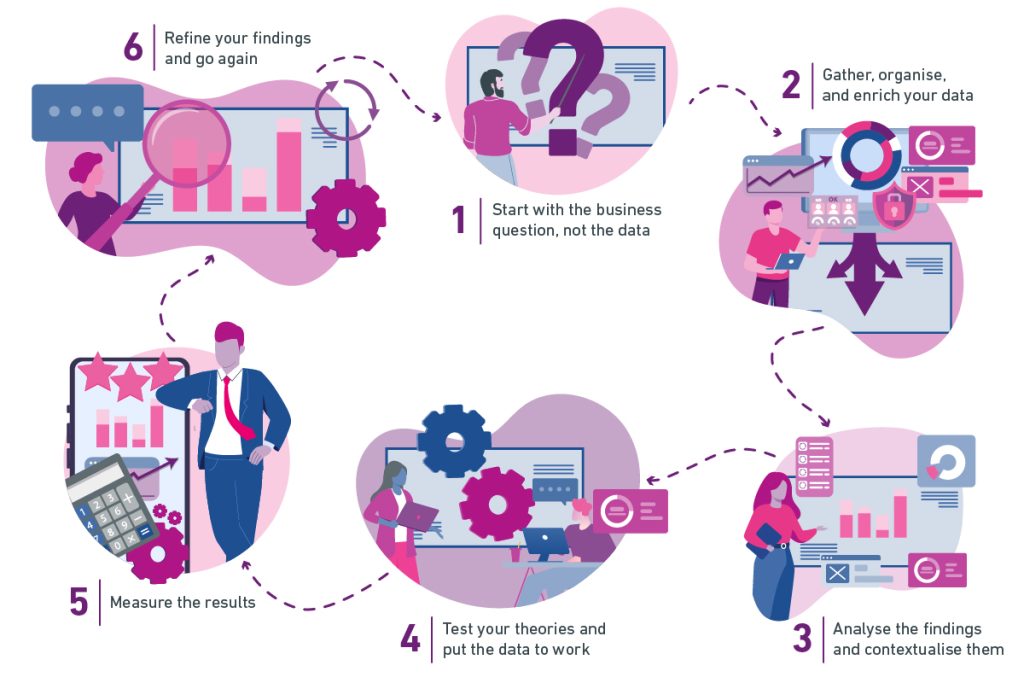
To make data manageable and ensure it drives effectiveness, we recommend six simple steps:
- Start with the business question, not the data: Clearly define your organisation’s objectives, key performance indicators (KPIs), and what you want to achieve through data-driven decision-making.
- Gather, organise, and enrich your data: Making sense of complex information relies on having a clear, systematic order to things. Collect data from all relevant sources, organise it into logical categories, and enrich it with additional information for deeper insights.
- Analyse the findings and contextualise them: Gen-AI tools and analytics software can help you spot trends and correlations quickly. Make use of them to cut down on your workload, but remember that the most valuable insights come from human interpretation. Link these findings directly to your business decisions, strategies, products, and marketing campaigns.
- Test your theories and put the data to work: Now you’re familiar with your data and have a strong understanding of audience segments, you can start to develop and test hypotheses. In marketing, this may involve experimenting with different messaging, creative, or placements. Where possible, base these theories on collective insights rather than isolated metrics.
- Measure the results: Continually measure performance against the objectives and KPIs you set during step one. The data doesn’t lie and will provide a clear, unbiased view of what is and isn’t working.
- Refine your findings and go again: Use the results to optimise and improve. Adjust your campaigns, products, or strategies based on what the data tells you then repeat the process to drive ongoing improvement.
Key takeaway
To get the best results from your data, define your goals from the start and treat your strategy as an evolving process. The more flexible you can be when it comes to analysis and execution, the better your results will be.
A note on data enrichment
A common frustration for many organisations is a lack of context around their data. CRM systems may hold mountains of information, but there’s often no meaningful way to join the dots and make sense of it.
A key step to resolving this is through data enrichment. This means taking those basic CRM records, such as names and emails, and enhancing them with trusted consumer insights, such as lifestyle, demographic, or transactional information to build complete customer profiles.
The benefits of this include:
- Deeper customer understanding by combining an individual’s preferences, behaviours, and life stages to create a richer, more comprehensive profile.
- Enhanced personalisation to deliver tailored experiences, product recommendations, and communications.
- Improved data quality by filling gaps in information, correcting inaccuracies, and ensuring completeness, making it more reliable and usable.
- Improved marketing ROI by reducing wasted ad spend and increasing engagement with highly targeted messaging and campaigns.
- Increased sales opportunities by identifying cross-selling and upselling opportunities to boost conversion rates.
Data marketing applications and techniques
With over 52 million consumers in the UK, businesses face a growing challenge in knowing how to use increasingly rich data to make smarter decisions, spend budgets more effectively, and deliver relevant experiences at scale.
It’s safe to say consumer data is at the heart of effective marketing, but where exactly do you start? We recommend focusing on these four key areas:
1. Precise audience targeting
Knowing who your customers are is Marketing 101. But when you combine different data types such as behavioural, transactional, and demographic, you can move beyond broad audience segments to target at more specific levels; such as postcodes, households, or even individuals. This isn’t about reaching more customers, it’s about reaching the right ones more effectively.
Such precision ensures campaigns are built around real people and real circumstances. This can become even more powerful when paired with smart contextualisation. For example, a meal-kit brand could serve ads for plant-based recipes to households in urban postcodes, where recent location and purchase data shows a rise in meat-free buying.
2. Personalisation at scale
Personalisation at scale means tailoring content, ads, offers, and experiences based on customer behaviour, preferences, and life stages across multiple channels, such as email or TV. Put simply, universal marketing campaigns no longer cut it.
A simple example to address this would be to split email audiences into meaningful segments rather than sending the same message to everyone. For example, customers who have purchased running trainers could receive emails with specific running and cardio exercise ideas, while those who have bought weightlifting trainers could receive strength exercise plans.
For digital campaigns, you could also use dynamic creative optimisation to change content in real-time based on who is viewing it and how they’ve interacted with your brand and products. This approach ensures every interaction feels timely and personal, even at scale.
3. Location intelligence
Location intelligence can help you understand where your customers are, and where your potential customers are emerging. By analysing geographical patterns, you can better prioritise the locations where your marketing spend should be used; optimise delivery areas and regional campaigns; see how demographics evolve over time; and even spot where competitors are gaining market share.
For example, a retailer with 20 locations can use location intelligence to identify which areas to invest in and which are declining. Data-backed insights like these provide clarity and confidence in what can often be costly decision-making.
4. Customer journey mapping
Customers will be interacting with your brand across multiple touchpoints both on and offline. Customer journey mapping brings all of these interactions together, creating a clear timeline of how someone discovers your brand, engages across channels, and then converts and makes a repeat purchase, or disengages.
By combining identity resolution and data connectivity, you can link digital identifiers, such as cookies or IP addresses, to create a unified view of behaviour over time. This then helps you understand which touchpoints deliver results so you can optimise and refine the customer experience.
Key takeaway
Data insights are the key to more effective and impactful marketing. Use different data types and placement possibilities to uncover new opportunities, get creative with campaigns, and drive success based on solid insight and analysis.
Measuring data-driven impact and success
You’ve put in the hard work to collect, enrich, and analyse data. Now’s the time to make sure that work is delivering true value.
Measuring campaign performance allows you to test your data-driven decisions and better understand their impact. Key metrics to measure include:
Conversion rates
Conversion rates show how effective your marketing has been at turning interest into action. This is done by measuring the percentage of users who complete a specific action, such as clicking an advert or visiting a website, out of the total audience reached.
Customer Lifetime Value (CLV)
CLV helps you uncover your most valuable customers and get a better understanding of overall customer loyalty, by estimating the total net profit you can expect from a customer over the course of their relationship with your brand.
Engagement rates
Helping you to measure genuine interest beyond views, engagement rates allow you to track how many people interact with your campaigns, such as commenting or sharing, relative to the advert’s impressions or your brand’s follower count.
Return On Investment (ROI)
By measuring the profit or loss generated by a campaign against the cost of running it, ROI shows which campaigns are delivering the greatest value and are therefore the most effective.
Ethical data use and compliance
Consumer concerns around data use, particularly when it comes to personalisation, can be a blocker to effective data-driven marketing. However, when data handling is carried out responsibly and transparently, adhering to robust data protection governance and regulations, like GDPR, it should feel helpful rather than invasive.
Ethical data use is a topic close to our heart as we helped shape the standards that guide it. Our Consumer Information Portal gives people real, practical control over how their data is used — setting a benchmark for transparency that the Information Commissioner’s Office expects and consumers increasingly demand..
Remember, responsible and ethical data use underpins everything. Best practice for handling consumer data includes:
- Clear transparency around how data is collected and used.
- Giving consumers choice and control on what information is gathered about them.
- Using privacy-enhancing technologies.
- Operating to the highest regulatory standards.
Key takeaway
Data understandably comes with strict protection policies and governance. It may seem like a minefield to stay on top of, but with transparency and consumer choice, you can keep both regulators and customers happy.
Ready to put consumer data to work?
Experian’s solutions give you access to rich, privacy-compliant consumer insight and analytics so you can understand and segment your audience, enhance your own data and make better strategic decisions.
From detailed demographic and behavioural data, to high-quality data enrichment and affordability insight that supports smarter credit and marketing decisions, our tools help you drive growth, reduce risk and deliver more relevant experiences.
Speak to our team to explore the right mix of solutions for your business.