

Why does data minimisation matter?
Data minimisation helps you meet personal data obligations, reduce security risks, and comply with key GDPR rules. It supports good customer service and also protects user privacy, as storing less data lowers the risk of data breaches. Collecting only relevant information can lead to clearer insights and more effective services and products.
What is data minimisation?
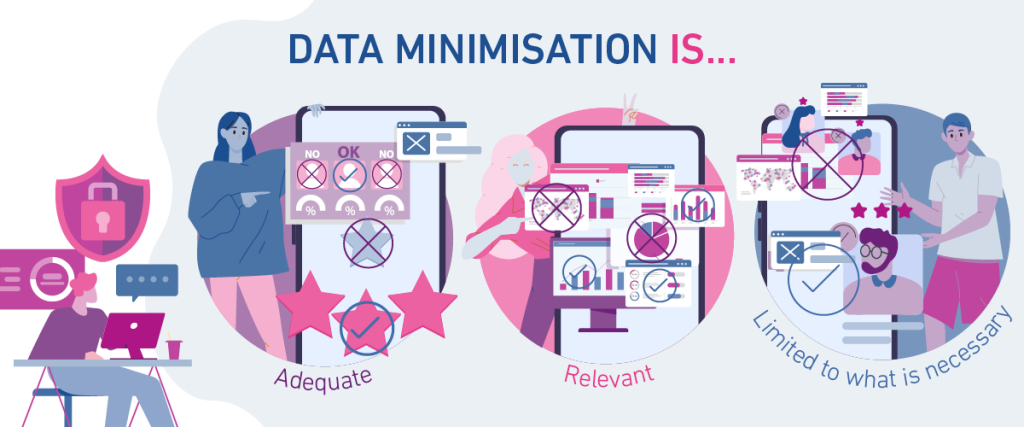
Data minimisation requires organisations to only collect, process and store data the minimum amount of personal data required for the specific intended purpose. It is a key principle of data. Under General Data Protection Regulation (GDPR), data minimisation is considered a core principle which outlines that data should be:
- Adequate
- Relevant
- Limited to what is necessary for the purposes for which they are processed.
In practice, data minimisation means your business should only collect the data needed for legitimate reasons and not gather any excessive or irrelevant information. You must also only store it for as long as necessary to fulfil its intended purpose, and regular reviews must be in place to prevent inaccuracies and ensure data is up to date.
Key takeaway
Data minimisation ensures you only collect, use, and store data that is relevant to your business needs. Adhering to this principle mitigates against data breaches and protects user privacy.
Data minimisation and GDPR
Data minimisation is vital in complying to GDPR regulations and fulfilling your company’s personal data obligations. Related to this is the accountability principle.
This states you must take responsibility for what you do with personal data, and be able to show you have the right processes in place to ensure you only collect and hold the specific data you require.
Data retention policies are also important. They ensure you keep data only for as long as needed. Regular audits help you stay compliant by checking, organising, and deleting data when necessary. Both data retention and regular audits support the storage limitation principle as set by the Information Commissioner’s Office (ICO).
The ICO stance is that businesses shouldn’t have more personal data than is necessary to achieve a purpose, and that data shouldn’t include irrelevant details.
Example
To understand data minimisation in context, let’s look at the gaming industry. To best assess a player’s affordability and gaming financial vulnerability, gaming operators are required to access credit bureau information around a player’s financial wellbeing, and from that operators can make responsible decisions on their credit limits.
However, operators should only gather information directly relevant to player spending. Collecting unrelated data breaches accountability and storage guidelines. It also increases security risks for both players and operators.
Key takeaway
Data minimisation is an essential part of your GDPR compliance and relates to several data principles as set by the Information Commissioner’s Office. These include data accountability, storage, and processing.
Risks and challenges of non-compliance
- Security and data breaches thanks to the risk of exposing unnecessary, irrelevant, or large volumes of data.
- Financial penalties with potential fines of up to £17.5 million or 4% of your annual worldwide turnover (whichever is higher), as set by the ICO.
- Reputational damage that comes with a loss of consumer trust and which could be catastrophic for your brand’s image.
Implementing data minimisation
To understand whether you are holding the right type and volume of data, you first need to be clear on why you’re using it. When collecting data in the first instance, have processes in place to consider:
- Does the individual know that your business is collecting data?
- How does the business plan to use it and does it align with established company goals?
- Does the individual know about the plans you have for their data?
- Is there a way to achieve those plans without collecting data?
- How long will your business need the data to achieve its plans?
By asking these questions, you can be clear on what data you do and don’t need at any one time, and therefore what can be deleted.
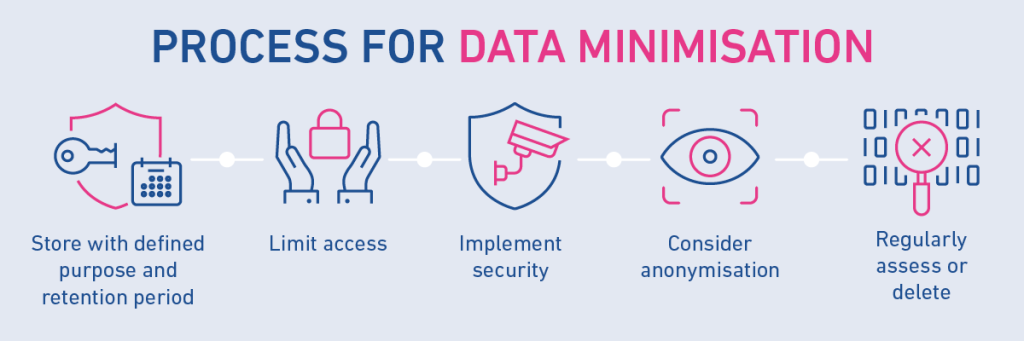
Then, once you have acquired the data you should:
- Store it in a logical way that clearly defines its purpose and retention period
- Limit data access to only those who need it to perform their job
- Implement robust security measures so the data is protected
- Consider if the data could be anonymised or pseudonymised to protect customer’s identities, while still being usable for processing or analysis
- Create regular review points to assess whether data is still needed and if you can delete it.
Key takeaway
Before you start collecting and working with data, there are several key questions your business should consider. By thinking about your company’s data goals and data quality processes from the get-go, you can make the data minimisation process even easier.
How we can help
Data minimisation is fundamental to data privacy obligations and ensuring GDPR compliance. Additionally, with a data minimisation approach you can reduce the risk of security breaches, avoid gathering an excess of unnecessary information, and even ensure a targeted approach to marketing and communications.
We provide tools and services to help businesses like yours manage and improve their data, ensuring accuracy and completeness. We can help you cleanse and validate customer data, improving the accuracy of your records, and implement data governance frameworks to ensure your data is well-understood and managed.