
Why AI matters for SMEs
In just 12 months, AI has gone from a novel productivity tool that businesses approached with curiosity to a core technology used to transform everyday tasks and processes. While SMEs vary from occasional users to enthusiastic adopters, one thing is clear: AI is no longer optional.
Many SMEs are hesitant to get fully on board with AI. While most will have dabbled, many are hesitant and have not embraced it at scale due to several barriers. This includes skills gaps in teams, concerns around costs, and uncertainty on its ROI.
In fact, UK SMEs report a lower rate of AI adoption than large businesses, and micro businesses are 45% less likely to adopt. This tentative mindset could mean SMEs get left behind if they aren’t using this technology. As AI advances, non-adopters risk falling behind their competitors in almost every area of their operations, and may struggle to catch up later.
The benefits of AI for SMEs
AI can provide economic and productivity advantages, and helps SMEs compete with larger organisations by providing access to advanced capabilities at lower cost.
- Saves time and costs by automating repetitive admin and operational tasks.
- Improves decision making by analysing large data sets quickly and highlighting actionable insights.
- Boosts productivity by enabling small teams to scale output without increasing or by reducing headcount.
- Enhances customer experience through faster responses, smarter routing, and more consistent service.
- Supports revenue growth by identifying sales opportunities and high-value prospects earlier.
- Enables scalable marketing by accelerating content creation and performance analysis.
- Strengthens compliance by embedding regulatory checks and controls into everyday processes.
- Improves efficiency by forecasting demand, optimising resources, and reducing waste.
- Speeds up product and service development by structuring feedback and supporting rapid iteration.
AI’s greatest value is in creating coherence and operational leverage for a business no matter its size. But for true success its usage requires clear objectives, high-quality data, tight governance, and human analysis.
How SMEs are using AI
AI has become core to operations
SMEs now use AI as an operational system with agent-like capabilities, automating and coordinating key workflows beyond using as a standalone tool or simple chatbot.
Process redesign delivers real value
The strongest results come from rebuilding processes around AI capabilities instead of adding tools on top of existing workflows.
Small changes outperform big overhauls
Targeted, incremental improvements that are measured and refined deliver more impact than large, one-off transformations.
Human judgement remains essential
AI provides speed, scale, and consistency, but people must review and interpret outputs, apply context, and decide next actions to avoid poor outcomes.
Balanced use creates advantage
SMEs that combine AI automation with human insight gain a sustainable competitive edge.
AI-risks to be aware of
Regulatory and compliance responsibilities
One of the biggest risks of implementing any new technology, not just AI, is ensuring regulatory compliance. This will understandably vary according to the sector and industry you’re in. However, with UK regulators taking a close look at organisations’ governance and consumer protection, there are some fundamental policies you need to have in place to ensure compliance with:
- GDPR
- Consumer law
- Employment law
- Transparency requirements
The casual nature of everyday use
Overestimating how simple it is to use AI or taking a plug-and-play approach to the technology can be detrimental to your company’s privacy policies and responsibilities. Similarly, staff misuse, such as the temptation to throw company information and documents into an AI tool without regard for privacy and sensitivity, could be disastrous.
Cybersecurity threats
So far we’ve taken an outward-facing view of AI, looking at how your workforce can use it to benefit the organisation and customers. However, it would be remiss not to acknowledge that many people interacting with your business will be using AI, some of which could be for sinister reasons.
AI-driven scams, such as deepfakes, voice cloning, or enhanced phishing can all bypass traditional security measures. To make sure you don’t fall foul of these cybersecurity threats, your business will need AI-native detection and security processes.
How and where to use AI within your business
Before you begin
As with any system or process, high-quality data is at the heart of operational success. AI will only ever be as good as the data it has access to. So if you’re working with unreliable, incomplete, or incorrect data, the output is going to be incorrect from the start. Make data preparation (that is, cleaning, structuring, and centralising the information) a priority before implementing any AI usage.
Ways to use AI in your business

Automate admin tasks
Automate your invoicing and payroll, set HR reminders, set up bespoke reporting, or undertake expense- or receipt-related tasks.

Create marketing and content drafts
Templates and first drafts can be strategised and created at scale, before being refined with a human touch.

Develop products and services more quickly
Collect and organise user feedback to support faster redesigns and better prototype iterations..

Ensure compliant operations
Better understand the risks and necessary compliance related to your business, and set up processes that help you adhere to regulations.

Generate ideas more quickly
Fast track innovation by brainstorming concepts and solutions, as well as ruling out ideas, more quickly.

Improve sales
Automate your sales prospecting and outreach, including outbound calls and demo invites, to reduce the need for a sales team. Complete CRM data entry, spot opportunities to cross- or upsell, and identify the behaviours and characteristics of high-value prospects.

Optimise business operations
Forecast and better understand demand, revenue, and resource requirements to help reduce waste.

Optimise the supply chain
Improve forecasting, logistics and inventory planning, and supplier management to spot cost-saving efficiencies.

Triage customers more effectively
Classify, prioritise, and route customers to the right area to improve the speed and accuracy of your customer service offering.

Undertake market analysis at scale
Automate and catalogue research, such as competitor monitoring or trend exploration.
Key considerations
1. Start small, progress meaningfully
Starting out with AI can feel overwhelming, particularly for SMEs who are often stretched as it is. But don’t feel pressured into using AI to automate everything at once. Identify the biggest time drains for you and your workforce or start with quick wins such as invoicing, HR onboarding, or customer support. Then, once you and your team feel comfortable, you can continue to implement AI across more areas of your business.
2. Remember, high-quality data is everything
Good AI output hinges on the quality of data you put in. Undertake a data cleansing project ahead of any AI implementation. Not only will this mean you start from a productive place, but you won’t have to go back and retrospectively fix errors in both your databases and AI systems.
3. Staff learning never ends, invest in consistent training
Your team’s AI knowledge and literacy should be prioritised ahead of hands-on experience with AI tools. Getting them comfortable with how AI works, especially within the context of your organisation, will help them understand and judge when they need to step in as the human moderator.
Think about introducing an Acceptable Use of Service (AUS) policy to provide clear, consistent rules on approved tools, data handling, and safe usage to your staff. This approach will reduce risk and guide responsible behaviour from day one.
4. Set realistic expectations and measure your ROI
Be realistic about what AI can and can’t do for your company and set clear objectives and goals based on this understanding. AI can create tangible value and impact, but this isn’t always immediate and requires measuring metrics such as efficiency, growth, and profitability.
It’s important to monitor the ongoing running costs of AI, as if not carefully managed the expenses can outweigh the benefits.
5. Establish clear AI governance policies
Manage risks ahead of time, feel confident in your compliance, and maintain trust with your workforce and customers by establishing clear AI governance policies.
Introduce clear AI guardrails to prevent inappropriate use of AI and ensure tools are applied safely and responsibly across your business.
As well as adhering to industry regulations, you may want to include information around how the tools are being selected, used, and monitored across your business.
What AI means for your workforce
Is AI really coming for our jobs?
It’s important to consider the fact that your workforce may be resistant to using AI. Yes, there are clear and significant benefits to all roles. However, the fear that this technology could replace them is a legitimate concern meaning they may simply not be on board with the technology. It’s essential to reassure staff on your company’s usage, constraints, and how their role works alongside it. Simply implementing AI technology in your organisation doesn’t automatically equate to human job losses.
Some of the benefits AI brings to your workforce include fewer manual (and repetitive) tasks, which means more time and headspace for top-level oversight or creative and client-facing work. Plus, depending on the size of your organisation, there’s opportunities for new roles or specialties, including AI operations, prompt engineering, or automation design.
Boosting output and productivity
Having to be agile and reactive by nature means most SMEs face the same problem: too much to do and an overstretched workforce unable to do it all.
With tight time constraints, many SMEs find themselves fragmented, leading to disconnected priorities, disjointed marketing, duplicated work, and low-quality or unreliable data. AI can help join the dots, bringing all these elements together to create a solid, streamlined foundation in which everyone can work from.
There’s no denying that with all the time and efficiencies saved from doing manual tasks, your workforces’ capacity can allow them to take on other, perhaps more interesting tasks and responsibilities. Not only is this great for morale, but by encouraging upskilling in all directions, your organisation can benefit from a more dynamic team.
Keeping your workforce informed
Skill gaps remain the main constraint and while many SME leaders trust AI’s capabilities and potential, there is a worry that staff don’t have the time or capacity to keep up with advancements. The UK government is aiming to resolve this with an upskilling initiative that will provide free AI training for 10 million workers by 2030.
Training and upskilling shouldn’t be left to the individual employee to figure out, and it shouldn’t be seen as an ‘end-of-the-day’ activity; something to do if the team has a spare 10 minutes here and there.
Formalising and prioritising AI training and upskilling is the responsibility of senior management who can standardise the learning to your organisation’s needs and apply constraints where necessary.
Putting boundaries in place
There is the very real risk that if your workforce default to using AI, those starting out in your company and junior members of staff will be at a disadvantage of real, hands-on learning with more experienced colleagues.
Critical thinking skills and human analysis are arguably the most important factors of working with AI. Being able to interpret and decide what to do with the information AI is presenting to you is essential. But if a junior relies on the output without the ability to judge and decide what to do next, the task at hand, your organisation, and the employee’s future skills are at jeopardy.
AI shouldn’t be seen or used as an autopilot alternative, and this sentiment should be clear across your internal usage policy.
Summary
- AI is now essential for SME competitiveness, driving productivity and efficiency while non-adopters risk falling behind.
- SMEs gain the most value when they redesign key processes around AI and improve them in small, measurable steps.
- High-quality data and human judgement are critical, as AI output only becomes useful when people interpret and act on it.
- Clear governance, security controls, and ongoing staff training ensure AI delivers value without increasing risk.
How can we help?
Experian helps SMEs use AI with confidence by providing trusted data, clear insight, and built-in controls that support smarter decisions. Our data quality and matching services ensure AI systems work from accurate, reliable information, while our credit, fraud, and identity solutions help manage risk, protect customers, and address regulatory requirements.
By combining advanced analytics with strong governance and human oversight, we enable SMEs to scale AI safely, improve efficiency, and compete effectively without increasing complexity or exposure.
Related services
Further reading

Getting a business loan: Your complete guide
Unlock business funding with our comprehensive guide. Learn about loan types, application processes, and funding options for growth.

Emailability – is it at the top of your list?
‘Emailability’. It’s not a word you’ll find in any dictionaries, but you instinctively know what it means. Do you know how emailable your prospects are?

Optimising Order-to-Cash: A Guide for Trade Creditors – Part 3
Automating decisioning systems can improve efficiency across the O2C process. Find out how Experian can revolutionise your business' credit control process.

Why crisis response planning is good for your business and its people
In the wake of the pandemic, the importance of resilience is foremost in the minds of many business leaders. But is your business ready to tackle any crisis?

BBLS analysis: how well are UK SMEs paying back BBLS loans?
Using data compiled from our bureau, this paper explores UK business's ability to pay back, and how lenders can reduce their own exposure.
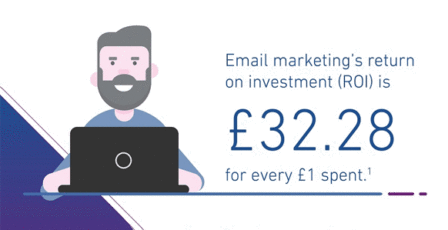
Infographic: Why email marketing should be a key channel in your 2019 B2B marketing plan
View our infographic to see why email marketing should be a key channel in your B2B marketing planning for 2019.

Developing your Business Overseas
Thinking of growing your business abroad? Download our free guide for tips on growing your business overseas.

5 Ways that Poor Cash Flow Can Damage your Business – and How to Prevent It
If your small business cash flow is something which keeps you up at night, then you're not alone. Learn more about how it can damage your business.

Small Business Tax Allowances
Small Business tax allowances are an important part of managing a business. Learn about the different types of tax including corporation tax and VAT here.