
Guide
What is a Company Registration Number (CRN) in the UK?
An employer’s guide to a Company Registration Number (CRN), what it is and why it is important for your business.

16 April 2026
read
Summary
- A Company Registration Number is a unique identifier issued by Companies House when a business is incorporated, and it remains permanently linked to that legal entity throughout its lifetime.
- It confirms a company’s legal existence and is required for essential activities such as filing accounts, paying corporation tax, opening a business bank account, and meeting statutory obligations.
- Only incorporated entities such as limited companies and LLPs receive a CRN, while sole traders and ordinary partnerships do not.
What is a Company Registration Number (CRN)?
The CRN serves as the legal foundation of a registered UK company and remains unchanged even if the company alters its name or registered address. Issued automatically by Companies House, the official public register of companies in the UK, a CRN acts as a unique identifier for every incorporated entity. Also referred to as a Company Number or Registered Number, the CRN is assigned at the point of registration. All companies and entities that attain separate legal personality are mandated to register with Companies House and are subsequently issued a CRN.
A company registration number is a unique combination of numbers and letters used to identify your company and verify its legal existence. Companies House issue a CRN during the formation/incorporation process. While companies can share similar names or phrases with other businesses, the CRN is unique and valid for the entire life of the company, cannot be changed, and no two companies will ever have the same number.
Who needs a CRN?
The types of companies and entities legally required to be registered with Companies House in the UK, and therefore issued a Company Registration Number (CRN), are those that choose to be incorporated (i.e., given a separate legal personality from their owners).
The primary categories are:
1. Limited Companies
These entities grant their owners limited liability, meaning the owner’s personal assets are generally protected from the company’s debts.
- Private Company Limited by Shares (Ltd): The most common structure for small-to-medium businesses.
- Public Limited Company (PLC): Used by larger businesses that can offer shares to the public. These have stricter rules and higher capital requirements.
- Company Limited by Guarantee (LBG): Often used by non-profit organisations, charities, or clubs where the liability of members is limited by the amount they agree to contribute to the company’s assets if it is wound up (the guarantee).
- Unlimited Company (Un LTD): Less common, this is still a registered company but its members have unlimited liability for the company’s debts.
2. Limited Partnerships
These structures provide certain partners with limited liability protection.
- Limited Liability Partnership (LLP): A legal entity separate from its members, typically used by professionals (e.g., accountants, lawyers).
- Limited Partnership (LP): A structure with at least one general partner (with unlimited liability) and at least one limited partner (with limited liability).
Businesses that do NOT receive a CRN
If you are a sole trader or general partnership (also known as ordinary partnership), you will not receive a CRN. Instead, you will register with HMRC and be taxed through Self-Assessment using your unique taxpayer reference (UTR) number.
Key takeaway
A CRN is a unique identifier of your company and legally verifies the authenticity of your business and its incorporation at Companies House. It is the legal foundation for a registered company in the UK.
What does a UK CRN look like? Here are some examples
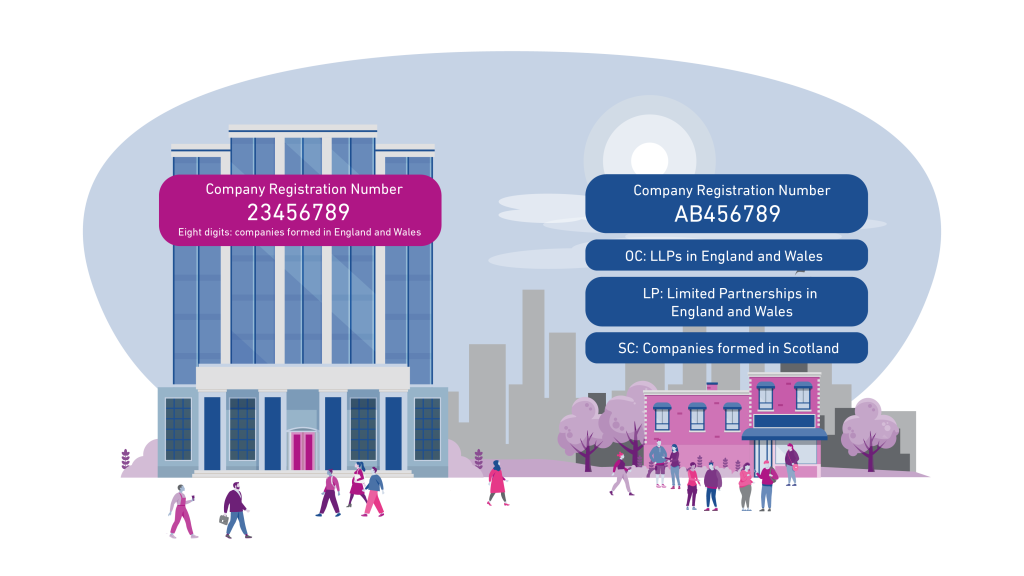
The typical format of a CRN is 8 characters long, made up of either 8 digits or 2 letters followed by 6 digits.
For example:
- Eight digits (e.g., 23456789)
- Two letters followed by six digits (e.g., SC456789)
- Two letters followed by three digits and three letters (e.g., RS005BEN)
A typical explanation of CRN format differences states that they vary by company type and location, as shown in the basic overview below:
- 8-digit number: Companies formed in England and Wales
- “OC” prefix: LLPs in England and Wales
- “LP” prefix: Limited Partnerships in England and Wales
- “SC” prefix: Companies formed in Scotland
- “SO” prefix: Scottish Limited Liability Partnerships (LLPs)
- “SL” prefix: Scottish Limited Partnerships
- “NI” prefix: LTDs in Northern Ireland
- “NC” prefix: LLPs in Northern Ireland
- “NL” prefix: Limited Partnerships in Northern Ireland
Below, you’ll find a complete overview of all CRN prefixes and suffixes seen in the companies’ house database in the last 20 years, and identified with the help of BusinessView.
| Company Prefix | Company Type |
| AC | Assurance Company for England & Wales |
| CE | Charitable incorporated organisation |
| CS | Scottish Charitable incorporated organisation |
| EN | European Company (Societas Europaea) for Northern Ireland |
| ES | European Company (Societas Europaea) for Scotland |
| FC | Overseas Company |
| FE | Further Education institutes |
| GE | European Economic Interest Grouping (EEIG) for England & Wales |
| GN | European Economic Interest Grouping (EEIG) for Northern Ireland |
| GS | European Economic Interest Grouping (EEIG) for Scotland |
| IC | ICVC (Investment Company with Variable Capital) |
| IP | Industrial & Provident Company |
| LP | Limited Partnership for England & Wales |
| NA | Assurance Company for Northern Ireland |
| NC | Limited Liability Partnership for Northern Ireland |
| NF | Overseas Company registered in Northern Ireland (pre 1st October 2009) |
| NI | Northern Ireland Company (post partition) |
| NL | Limited Partnership for Northern Ireland |
| NO | Northern Ireland Credit Union Industrial/Provident Society |
| NP | Northern Ireland Industrial/Provident Company or Credit Union |
| NR | Northern Ireland Royal Charter Companies |
| NV | Northern Ireland ICVC (Investment Company with Variable Capital) |
| NZ | Unregistered Companies (S 1043 Not Cos Act) for Northern Ireland |
| OC | Limited Liability Partnership for England & Wales |
| OE | Overseas Entity |
| PC | Protected Cell Company |
| R0 | Northern Ireland Company (pre partition) |
| RC | Royal Charter Companies (English/Wales) |
| RS | Registered Society |
| SA | Assurance Company for Scotland |
| SC | Scottish Company |
| SE | European Company (Societas Europaea) for England & Wales |
| SF | Overseas Company registered in Scotland (pre 1st October 2009) |
| SG | Scottish Qualifying Partnership |
| SI | Scottish ICVC (Investment Company with Variable Capital) |
| SL | Limited Partnership for Scotland |
| SO | Limited Liability Partnership for Scotland |
| SP | Scottish Industrial/Provident Company |
| SR | Scottish Royal Charter Companies |
| SZ | Unregistered Companies (S 1043 Not Cos Act) for Scotland |
| ZC | Unregistered Companies (S 1043 – Not Cos Act) for England & Wales |
| Company Suffix | Company Type |
| A | Specially Authorised Society |
| B | Building Society |
| BENS | Benevolent Society – Scottish |
| C | Credit Union |
| CU | Credit Union in Northern Ireland |
| CUS | Credit Union Scotland |
| EN/BEN | Benevolent Society |
| F | Friendly Society |
| FG | Only 2 companies. Both companies no longer active. |
| FI | Friendly Society – Irish |
| IP | 1 company only. Registered under the Industrial and Provident Societies Acts (Northern Ireland 1969 and 1976) |
| O | Only 2 companies. Both companies no longer active. |
| R | Societies registered under the Co-operative and Community Benefit Societies Act 2014 before 1 August 2014. |
| RS | Society in Scotland registered under the Co-operative and Community Benefit Societies Act 2014 before 1 August 2014. |
| S | Linked to Credit Unions. Not clear how this is different to suffix C. |
| T | Only 2 companies. Both companies no longer active. |
| W | Working Men’s Club |
| WS | Working Men’s Club – Scottish |
| Z | Co-operative Society |
Please note that Companies House occasionally introduces new suffixes in company CRNs, and that the list is often evolving. The table above focuses primarily on the most commonly queried suffixes.
Where should my CRN be displayed?
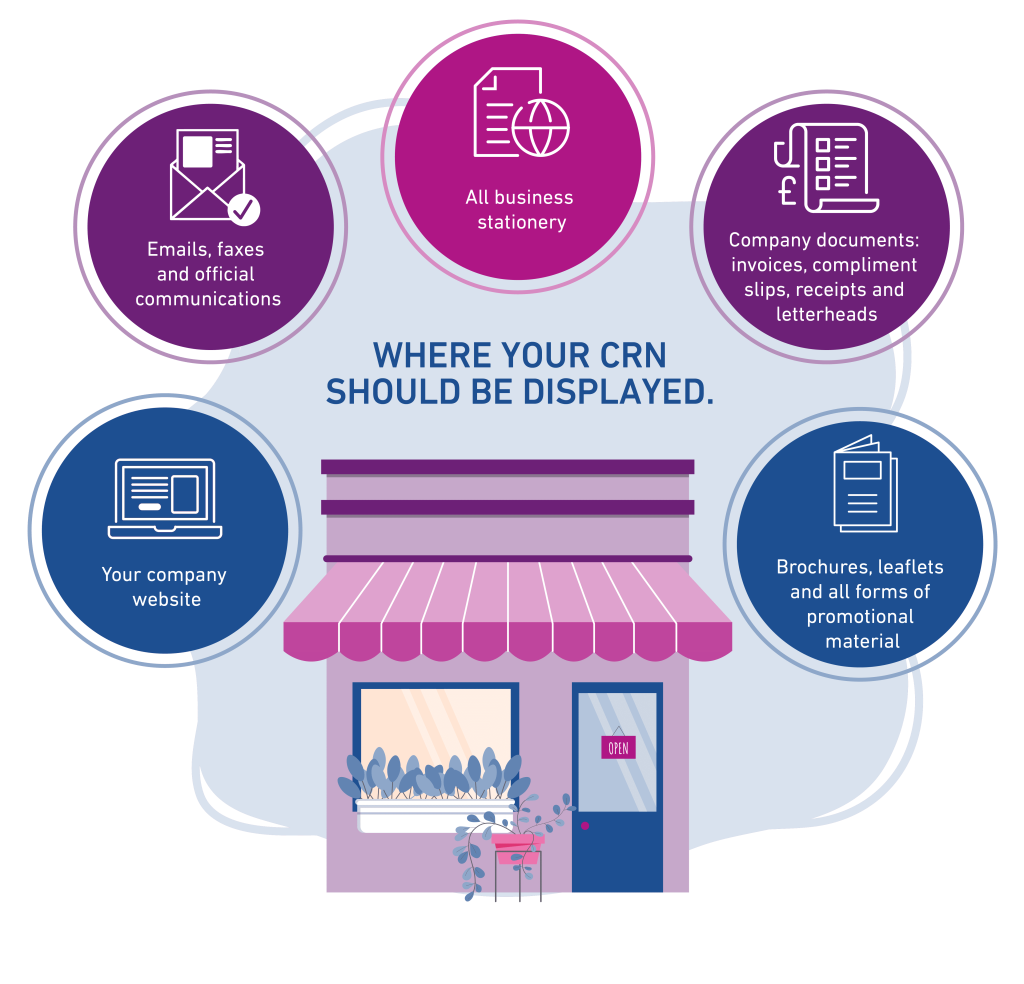
If you are a UK-based limited company or LLP (limited liability partnership) you are legally required to display your CRN on:
- Your company website
- Emails, faxes and official communications
- All business stationery
- Company documents such as invoices, compliment slips, receipts and letterheads
- Brochures, leaflets and all forms of promotional material
Find out more about your responsibilities when running a limited company on Gov.UK >
Financial penalties for not displaying the CRN
- Initial penalty: Failure to display your CRN may result in a fine of up to £1,000 for a first offence. This applies whether the omission occurs once or is part of a recurring pattern.
- Ongoing fines: If you remain non-compliant after warnings or the initial penalty, Companies House can issue daily fines of up to £100 until you resolve the breach. These daily charges can quickly accumulate if left unaddressed.
Enforcement consequences for not displaying CRN
- Formal warnings: Companies House may issue official warnings to directors who fail to display their CRN as required. Disregarding these notifications can result in further consequences.
- Escalation of enforcement: Ongoing non-compliance or repeated breaches may lead to public censure, mandatory compliance directives, and potentially further legal proceedings.
- Personal liability for directors: Directors who continually neglect their obligations can be held individually accountable. In serious instances, they risk being disqualified from serving as a director under the Company Directors Disqualification Act 1986.
Common myths about Company Registration Numbers (CRNs)
Despite being a fundamental business identifier, Company Registration Numbers are often misunderstood. Below are some of the most common misconceptions UK business owners and professionals encounter.
Myth 1: Every CRN ever issued can be found on the Companies House website
A common misconception is that all Company Registration Numbers ever issued by Companies House can be looked up on the public Companies House register.
In reality, this is not always the case.
While Companies House maintains a comprehensive public register of active companies and many recently dissolved entities, older companies that were dissolved, struck off, or closed many years ago may no longer appear in standard public search results. As a result, a CRN that once existed may not be retrievable through a simple Companies House lookup today.
This is particularly relevant when:
- Investigating historical businesses
- Verifying legacy suppliers or counterparties
- Analysing long‑term commercial or credit data
- Researching companies dissolved before modern digital records were standardised
The absence of a CRN from the public register does not necessarily mean the number was invalid. It may simply relate to a company that no longer appears in publicly accessible records.
Myth 2: If a company changes its name, it receives a new CRN
A Company Registration Number is permanent and does not change if a company:
- Changes its name
- Changes its registered address
- Changes directors or shareholders
- Rebrands or adopts a new trading name
The CRN remains the single, consistent legal identifier for the company throughout its entire lifecycle.
Myth 3: Sole traders and partnerships have CRNs
Only incorporated entities receive a Company Registration Number.
Sole traders and ordinary partnerships do not have a CRN because they are not registered as separate legal entities with Companies House. Instead, they are registered with HMRC and identified using a Unique Taxpayer Reference (UTR).
This distinction is important when carrying out compliance checks or onboarding new business partners.
Myth 4: A CRN proves a company is trustworthy
A CRN only confirms that a company has been legally incorporated. It does not:
- Confirm financial stability
- Indicate good payment behaviour
- Guarantee the company is actively trading
- Reveal insolvency risk or fraudulent activity
For this reason, a CRN should always be treated as a starting point, not a complete due‑diligence check, when entering into a business relationship.
Myth 5: CRNs are reused once a company is dissolved
A Company Registration Number is unique and is not reassigned to another company, even after the original company has been dissolved.
This ensures that each CRN remains permanently associated with a single legal entity, helping to maintain historical accuracy and prevent confusion or misuse.
Where can I find my CRN?
You can find your CRN on:
- Your certificate of incorporation – received when you register your company with Companies House
- Any official Companies House documents
- Documents or communications from your company formation agent or accountant
- The public register of companies, which can be accessed via the Companies House Register
CRN vs other business numbers (CRN, UTR, VAT, PAYE)
| Identifier | Issued by | Who gets it | What it’s used for |
| CRN (Company Registration Number) | Companies House | Incorporated companies & LLPs | Legal identity of the company |
| UTR (Unique Taxpayer Reference) | HMRC | Companies, sole traders, partnerships | Tax reporting |
| VAT Number | HMRC | VAT‑registered businesses | Charging & reclaiming VAT |
| PAYE Reference | HMRC | Employers | Payroll & employee tax |
Can two companies have the same CRN?
No. Two companies can never have the same Company Registration Number (CRN).
A CRN is globally unique within the UK and is permanently assigned to one legal entity only at the point of incorporation. Even if a company is later dissolved, struck off, or restored to the register, its CRN remains exclusively linked to that original entity and is never reused.
While different companies may share:
- Similar or even identical names (subject to naming rules)
- The same directors
- The same registered address
They will always have different CRNs.
Why does this matter? When carrying out due diligence, the CRN is more reliable than a company name, which can change over time or be reused by new entities.
Do dormant companies still have CRNs?
Yes. Dormant companies retain their CRNs.
A company that is classified as dormant by Companies House:
- Still legally exists
- Remains on the public register
- Continues to be identified by the same CRN
Dormancy simply means the company has had no significant accounting transactions during a financial period – not that it has ceased to exist.
Even if a company:
- Has never traded
- Has temporarily stopped operating
- Is holding assets or intellectual property but not operating
Its CRN remains valid and active.
Do charities have CRNs?
Some charities have CRNs, but not all. Whether a charity has a CRN depends on how it is legally structured.
Charities that do have CRNs include
- Charitable companies limited by guarantee
- Charitable incorporated organisations (CIOs that are also registered companies)
These charities are incorporated at Companies House and therefore receive a CRN, just like any other company.
Charities that do not have CRNs
- Unincorporated charities
- Trusts
- Associations
These entities are typically registered only with the Charity Commission and do not have a CRN, although they may have:
- A Charity Registration Number
- A UTR for tax purposes
A charity may have:
- A CRN
- A Charity Commission number
- Both
- Or neither (depending on structure)
Always check the legal form of the organisation.
How can we help?
Before entering into a business relationship, it’s essential to go beyond a Company Registration Number and ensure the company you’re dealing with is legitimate, financially stable, and not linked to fraudulent activity.
Experian provides business credit reports and risk assessments to help you:
- Verify legitimacy: Confirm a company is properly registered and not a fraudulent entity.
- Check financial stability: Assess credit scores, financial history, and payment behaviour.
- Reduce risk: Identify warning signs of insolvency, late payments, or potential scams.
- Make informed decisions: Gain insights before signing contracts, offering credit, or forming partnerships.