
Mosaic Financial
Financial segmentation groups and types
Understand your segments
This latest release introduces a sharper view of the UK’s financial landscape, with new affluence-based groups to identify segments with investable assets, mortgage potential, and financial planning needs.
With an aging population, we’ve refined distinctions among older consumers for more accurate engagement as well as enhanced granularity for younger households - supported by richer student data - ensuring segmentation reflects real financial lifestyles and attitudes, not just product holdings.
Jump to segment:
A - Financial Fledglings | B - Fast-track Futures | C - Salary Spenders | D - Payday Singles | E - Portfolio Powerhouses | F - Wealth Generators | G - Committed Families | H - Budget Navigators | I - Parental Pressures | J - Cost-conscious Singles | K - Mature Accumulators | L - Combined Resources | M - Home Stretch Workers | N - Asset Guardians | O - Senior Assurance | P - Pension Sufficiency | Q - Lifelong Budgeters
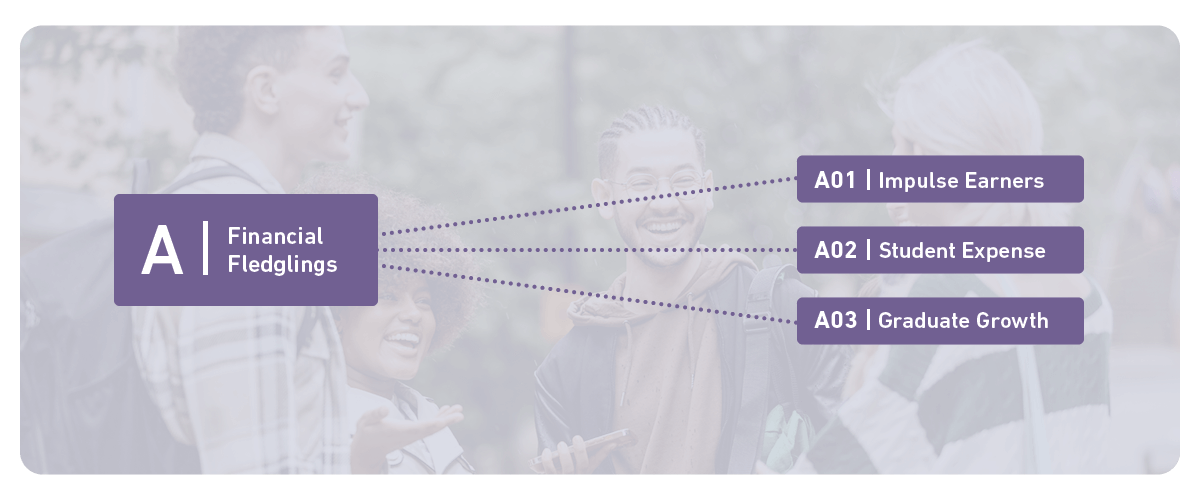
A: Financial Fledglings
Young people pursuing independence through university or first jobs in affordable housing and taking their first steps into personal finance.
Key Features:
- Very young single adults
- Low financial footprint and affluence
- Renting low cost flats
- Low credit spend limits
- Tend to budget but often overspend
- Daily smartphone banking


A01: Impulse Earners
Independent young people with very little financial experience, often overspending their entry-level wages and have limited savings.
Key features:
- Very young singles living alone
- Living in affordable housing on basic incomes
- A-level or lower education
- Low financial footprint and knowhow
- Low discretionary income
- Often overspend budget
A02: Student Expense
Students living close to universities, relying on loans, parental support, and part-time jobs, often spending over budget.
Key features:
- Young university students living together
- Student loans and parental support
- High smartphone usage including banking
- Spend money socially
- Prioritise mobile expenses
- Often overspend budget
A03: Graduate Growth
Graduates with a promising financial trajectory, who are currently enjoying their entry-level salaries and building their financial footprint.
Key features:
- Young singles living alone
- Graduate incomes
- Recent movers
- Limited financial history
- Seek value for money and introductory offers
- Buy city getaways and luxury items
B: Fast-track Futures
Highest earning, young professionals renting expensive city centre homes who have very high spending power whilst building assets.
Key Features:
- Young career-driven professionals
- Highly educated and affluent
- Tech and finance roles
- Significant spending
- Considerable savings
- Confident investors


B04: Flourishing Finances
Younger city professionals with top tier incomes, who are able to spend freely whilst investing to grow wealth early.
Key features:
- Young singles living alone
- Excellent salaries in expensive central areas
- Multiple bank accounts and credit cards
- Enjoy taking risks on digital assets
- High spend on holidays and quality brands
- Save significant sums
B05: Wealth Builders
High-earning young homesharers, who are smart spenders prioritising cash savings and investments.
Key features:
- Young singles living alone
- High incomes in high cost cities
- Beginning to build assets
- Prioritise cash savings and investments
- Enjoy holidays abroad buying budget flights
- Spend freely and not afraid to dip into savings
C: Salary Spenders
Aspiring singles on good salaries and focussed on career progression, who rent accessible apartments, tending to spend more than save.
Key Features:
- Single professionals
- Good salaries
- Renting but looking at mortgages
- Willing to take risks
- Saving not a high priority
- Financially savvy online


C06: Going Places
Career-driven young professionals, commitment-free, spending socially and open to risk over saving.
Key features:
- Young singles living alone
- Recent movers renting
- Recently university educated
- Low financial commitments
- Disposable income spent on city breaks
- Save money through accessible accounts
C07: Metro Bound
Singles and homesharers earning respectable salaries in big cities, but have limited saving capabilities due to high living costs.
Key features:
- Singles living either alone or with flatmates
- Earn above average incomes
- High rent costs in well connected cities
- Limited disposable income
- Prefer sustainable brands
- Varied levels of savings
C08: Professional Progress
Established singles and couples with good career progress, starting to build savings and managing finances online.
Key features:
- Singles mostly living alone
- Transitioning to mortgages
- Higher level work roles that require a degree
- Healthy disposable incomes
- Several bank accounts and credit cards
- Make regular savings
D: Payday Singles
Single people with small budgets in affordable private rents, managing finances payday to payday but with limited ability to save.
Key Features:
- Singles renting flats with or without others
- Full time below average incomes
- Limited saving capability
- Little financial history
- Smartphone banking
- Use public transport often


D09: Supported Jugglers
Economically active adults, some with children, receiving government support whilst working part-time and pursuing further education.
Key features:
- Young singles renting with housemates
- Mix of students and young workers
- Looking for and starting careers
- Basic incomes and disposable income
- Limited savings
- Favour online options
D10: Pragmatic Solos
Singles earning adequate incomes, mostly sticking to their budget and may seek financial advice as they struggle to save.
Key features:
- Singles and sharers
- Below average income
- Credit cards used cautiously
- Small financial footprint
- Actively save but struggle to do so
- Mostly stick to budget
D11: Cost-cutting Singles
Working age singles, who earn below average wages and may need to access low amounts of credit if falling short.
Key features:
- Working age singles living alone
- Homeowners and renters of low priced flats
- Limited discretionary income
- Prioritise saving for emergency funds
- Low levels of savings
- Carefully budget
D12: Frugal Roomers
Singles and homesharers on minimum wages or unemployed, receiving support, valuing low costs and short-term commitments.
Key features:
- Working age singles and sharers
- Minimum wage jobs
- Rent low cost flats
- Spontaneous in decision making
- Low levels of savings
- Occasionally overspend budget
E: Portfolio Powerhouses
Financially astute, high-net-worth households with substantial assets, residing in premium value homes around major cities
Key Features:
- Affluent middle-aged households
- Highly educated senior managerial roles
- Considerable assets alongside property
- High spending power
- Spread and use their money wisely
- Risk takers to build their portfolio


E13: Top Tier Elites
Super wealthy families owning luxury, city homes, live first class lifestyles, using tailored advice to manage wide-ranging investments.
Key features:
- Families, often with children
- Highest incomes, company benefits
- Senior level positions and directors
- Many investments including property
- High mortgages, many investments
- Luxury spending habits
E14: Capital Titans
Older, wealthy corporate owners, who invest strategically but have a high appetite for risk to grow their already vast fortunes.
Key features:
- Older couples with adult or teenage kids
- Very expensive detached properties
- Very high income from directorships
- Many investments including property
- High use of financial advice
- High risk appetite to build big portfolio
E15: Legacy Investors
Experienced, older professionals earning high salaries, who have accumulated many investments as they prioritise saving for retirement.
Key features:
- Older singles, some living with others
- Very high value city centre homes
- High salaries and bonuses
- Accumulated many investments
- Range of insurance products
- Prepared to take risks for higher gains
F: Wealth Generators
Successful families with children, owners of high value family homes, investing in the growth of their families and their assets.
Key Features:
- High income families
- Large homes of sizeable value and mortgages
- Healthy disposable incomes spent on holidays
- Confident with money
- Influenced by interest rates
- Informed on financial matters


F16: Mortgage Masters
High earning families with very large mortgages, benefitting from corporate perks and using financial advice to grow their assets.
Key features:
- Families with primary and teenage kids
- High mortgages on big family homes
- Very high salaries and company benefits
- Excellent assets and savings
- Research financial products meticulously
- Substantial investable assets
F17: Smart Upgraders
Financially astute young families with solid incomes, using savings accounts and comparison sites to manage money wisely.
Key features:
- Young families with dual incomes
- High salaries and healthy income
- Mortgages on higher value new build homes
- Diverse portfolio of savings and investments
- Active in switching and insurance renewal
- Regularly use comparison websites
F18: Savvy Switchers
Busy families with growing kids, juggling jobs and family life, using mobile banking often and actively switching financial products.
Key features:
- Families with primary or teenage kids
- Parents working, often one part-time
- Good levels of income and savings
- Proactive with their finances
- Active switchers
- Daily smartphone banking
F19: Urban Maximisers
Families with two good salaries, with high mortgages and source financial information online.
Key features:
- Families and some singles with children
- Expensive locations with high mortgages
- Maximised mortgage potential
- Financially engaged using most channels
- Good levels of disposable income
- Keep good levels of savings for instant access
G: Committed Families
Young family households, with high numbers of adults working and high commitments, carefully planning payments and switching often.
Key Features:
- Young families with decent salaries
- High outgoings with mortgages and children
- Workplace pensions
- Seek out value for money
- Some savings in easy access accounts
- Accrue financial provisions for family


G20: Loan Lifters
Average wage young families with mortgages on more affordable homes, actively switching suppliers and using loans for funding.
Key features:
- Young families on average wages
- Own affordable modern houses
- Dual income to pay off mortgages
- Cars are essential, bought on finance or loans
- Usually stick to monthly budgets
- Actively renew insurance for better offers
G21: Dual Dilligence
Couples with children, with two mid-range salaries, owners of modest family homes, with well-planned finances.
Key features:
- Couples with children
- Dual income with mid-range salaries
- Actively switch mortgage providers
- Financial decisions planned, not impulsive
- Building modest savings, some use of loans
- Use smartphone banking regularly
G22: Millennial Movers
Young, often single, households with good salaries who have mortgages and use comparison sites for financial essentials.
Key features:
- Young singles, some with children
- Good salaries, full-time workers
- Own more affordable recently built homes
- Well disciplined with budgeting
- Small secondhand cars bought with finance
- Regular usage of comparison websites
G23: Independent Mortgages
Single homeowners, some with children, on good salaries taking on above average mortgages on below average value homes.
Key features:
- Single parents
- Independently paying mortgages
- Moved recently to reasonably priced homes
- Low savings for emergencies and holidays
- Spend within budget on single incomes
- High use of comparison sites
H: Budget Navigators
Modest income young households, owning or renting low value terraces and making budget-conscious choices.
Key Features:
- Couples and singles with young children
- Slightly below average incomes
- Actively save
- Some reliance on loans
- Low cost holidays
- Passive financial activity


H24: Sensible Settlers
Average income singles and couples, some with children, keeping costs sensible in affordable old suburban terraces.
Key features:
- Singles and couples, some with children
- Mortgages on affordable suburban terraces
- Average incomes, most adults in paid work
- Savings spent on buying first home
- Mortgage payments take up a lot of cost
- Spend within budget
H25: Price-conscious Parents
Couples and singles with young children, stretching limited wages to cover low tier housing payments and family costs.
Key features:
- Couples and singles with children
- Below average wages
- Mix of owners and renters
- Low disposable income
- Minimise costs where possible
- Use loans and credit when necessary
H26: Discount Renters
Young households, some with children, keeping costs to a minimum, renting very low value, densely packed old terraces.
Key features:
- Younger households, some with children
- Very low value older terraces with small plots
- Most rent with some low price purchasing
- Minimum wages and some financial support
- Low disposable incomes
- Smartphones an essential cost
I: Parental Pressures
Families renting low value houses from social landlords, with little to spare after essentials.
Key Features:
- Low income families
- Limited incomes and some unemployment
- Low cost council housing
- Struggle to make regular savings
- Short term borrowing
- Eligibility for state benefits


I27: Socially Strapped
Longstanding social housing tenants, with high levels of unemployment, searching online for low cost options.
Key features:
- Couples and singles with children
- Tenants of low value social houses
- Many unemployed and government supported
- Managing on income is difficult
- Shop online to find cost-saving options
- May use short-term credit
I28: Boxed-in Budget
Multi-generation families, in social housing who do not own financial or savings products and have little cash to spare.
Key features:
- Multi-generational families
- Tenants of low value social houses
- Low numbers in paid work
- Hard to make ends meet
- Very limited or no savings
- May use short-term credit
I29: Practiced Persistence
Older families with adult or teen children, who rent social houses in expensive areas, combining low resources to get by.
Key features:
- Older families with adult or teen children
- Social rented houses in expensive regions
- Low wages, some not in paid work
- Dual incomes help finances
- Basic bank accounts
- Try to stick to budgets
J: Cost-conscious Singles
Low income tenants of social flats, striving with challenging budgets.
Key Features:
- Working age singles living alone
- High unemployment
- Day-to-day budgeting
- Short term borrowing
- Low car ownership
- Eligibility for state benefits


J30: Basic Finances
Singles, earning minimal wages and have basic banking and others unemployed with low financial engagement.
Key features:
- Singles living alone
- Social flats with higher property value
- Minimal wages, some not in workforce
- Basic bank accounts
- Low engagement with financial products
- Buses to get around
J31: Struggling Solos
Mature singles in low cost social flats with low numbers in work, stretching a state-supported income with minimal discretionary income.
Key features:
- Mature singles living alone
- Very low, state-supported income
- Low value social homes
- Many not in work
- Fuel bills are challenging
- Work hard to stick to budget
J32: Resilient Youth
Young people, some with children, with low economic activity who struggle to manage incomes even with state-support.
Key features:
- Young singles living alone or with housemates
- Some households with children
- Renting very low value social flats
- Difficult to manage on very low income
- May use payday loans
- A lot unemployed and receiving benefits
K: Mature Accumulators
Older families who own good quality homes and prioritise pension saving.
Key Features:
- Mature households
- Above average dual incomes
- Own properties outright
- Retirement saving is top priority
- Use credit cards for higher levels of spending
- Manage their money well


K33: Interest Seekers
Entrepreneurial older families, with very high levels of disposable income, owning multiple bank accounts motivated by interest rates.
Key features:
- Older couples living with adult children
- Very good household income
- Many small business owners
- Good range of assets
- Take on some risk for better returns
- Personal pensions and SIPP
K34: Inheritance Builders
Maturing families with good incomes, using online channels to bank and shop, building attractive legacies for their children.
Key features:
- Maturing families with teen or adult children
- Good value properties and incomes
- Many small business owners
- Healthy savings and personal pensions
- Browse and buy online
- Building assets for their children
K35: Content Couples
Older couples and families with secure finances and average income who enjoy a comfortable standard of living.
Key features:
- Older couples and families
- Transitioning to retirement
- Little or no mortgage
- Comfortable standard of living
- Regular credit card use
- Savings across multiple accounts
K36: Retirement Planners
Older working age singles with comfortable incomes and assets, looking to retirement.
Key features:
- Older singles living alone
- Most still working in senior roles
- Financial focus on retirement
- Conservative with spending
- Regular credit card use
- Save by hunting the best interest rates
L: Combined Resources
Older families with adult children, working towards outright ownership of mid-size homes, using loans to fund big expenses.
Key Features:
- Older families with adult children
- Combined below average incomes
- Mid market property value
- Working towards outright ownership
- Use loans for larger expenses
- Reasonable savings


L37: Smart Borrowers
Families with adult children, with mortgages and workplace pensions, using comparison sites to research loans for large purchases.
Key features:
- Extended families with adult children
- Mid-market houses owned with mortgage
- Legacy life insurance policies
- Active in insurance renewal
- Use of unsecured loans for large purchases
- Workplace pensions
L38: Home-rich Budgeters
Older households with good home equity but low spending power, likely beneficiaries of house price rises in urban areas.
Key features:
- Older households with adult children
- Below average incomes
- Many settled with mortgage paid off
- Good home equity
- Seek trustworthy financial providers
- Saving for retirement
L39: Everyday Repayers
Basic wage owners living alongside adult children in value for money homes, gaining additional funding from loans when required.
Key features:
- Older families with adult children
- Minimum wage incomes
- Multiple incomes provide robust budget
- Low mortgage amount
- Unsecured loans for bigger purchases
- Shop around for value products
M: Home Stretch Workers
Average income households, nearing the end of mortgage payments on inexpensive homes, looking forward to finishing their working lives.
Key Features:
- Mature singles and couples
- Slightly below average incomes
- Winding down for retirement
- Manage budgets sensibly
- Risk averse
- Mostly invest in pensions


M40: Single Persistence
Mature single owners of affordable houses, approaching retirement with some security, having spent and saved to match their income.
Key features:
- Older singles living alone
- Below average income
- Paid off mortgage
- Regularly save
- Low risk investment products
- Carefully budget holidays
M41: Rural Resolvers
Older owners of affordable rural homes, managing on below average incomes, with high energy and transport costs due to their locations.
Key features:
- Older couples and singles
- Slightly below average income
- Higher energy costs
- Shop around for value products
- Contribute to personal pensions
- Car ownership essential
M42: Steady Savers
Mature, home owners approaching mortgage freedom, saving for retirement and holidays, in value suburbs and smaller communities.
Key features:
- Older couples, empty nesters
- Average pro-rata income
- Many at point of paying off mortgage
- Prefer post or phone communication
- Spend within their means
- Saving for retirement and holidays
N: Asset Guardians
Financially sophisticated retired and pre-retirement households with high incomes, assets and expensive homes.
Key Features:
- Retirement age singles and couples
- Expensive homes owned outright
- Comfortable finances
- High levels of discretionary income
- Willing big spenders in retirement
- Actively seek financial advice


N43: Portfolio Elders
Wealthy retirees in expensive homes with wide ranging investments held in a sophisticated portfolio.
Key features:
- Retired couples and singles
- Excellent retirement income
- High spending power
- Large expensive homes owned outright
- Many investments and assets
- Financially sophisticated
N44: Senior Stakeholders
Mature households with very high assets who could comfortably retire but maintain part-time directorship roles.
Key features:
- Mature couples and singles
- Large expensive homes owned outright
- High incomes even in retirement
- Discuss financial decisions with experts
- High investable and non-liquid assets
- Use of legal services for wills and probate
N45: Golden Guarentees
Senior people who benefit from excellent final salary pensions and own a wide-range of financial products.
Key features:
- Financially secure senior couples
- Excellent pensions
- Substantial assets and savings
- Sophisticated investment portfolio
- Several credit cards
- High disposable incomes
O: Senior Assurance
Retired singles and couples with solid final salary incomes, good home equity and cash available for purchases and leisure pursuits.
Key Features:
- Retirees, both singles and couples
- Own above average valued properties outright
- Long length of residencies
- Financially cautious
- Enjoy secure pension incomes
- Savings and investments


O46: Lasting Security
Elderly singles in quality homes with a final salary pension and savings that provide certainty and a comfortable standard of living.
Key features:
- Final salary pension singles
- Well-managed finances
- Good levels or savings and assets
- Value trustworthy brands
- Consider accessibility of branches
- Regular credit card use
O47: Pension Freedom
Settled retired couples living securely on solid final salary pensions, mortgage free with good home equity and resources for holidays.
Key features:
- Married retired seniors
- Comfortable combined incomes and savings
- Regularly upgrade their cars
- Excellent credit record
- Regular credit card use
- Comprehensive insurance coverage
O48: Countryside Cash
Ageing singles and couples on moderate pensions, enjoying countryside retirement with comfortable savings to fund bigger purchases.
Key features:
- Retired couples and singles
- Own outright generous rural homes
- Good savings and disposable incomes
- Use savings for big purchases
- Moderate use of credit cards
- High heating costs
P: Pension Sufficiency
Elderly singles and couples with a modest income uplift beyond the state pension, who are outright owners of below average value homes.
Key Features:
- Elderly singles and couples
- Own below average valued properities outright
- Adequate pension incomes
- Sensible budgeting and cautious
- Manageable finances
- Risk averse


P49: Convenient Classics
Elderly individuals with liveable pensions, mortgage free using credit cards for convenience spending and conventional ways of banking.
Key features:
- Elderly singles
- Own outright below average priced homes
- Pensions topped up by state provisions
- Straightforward savings accounts
- Credit cards for convenience spend not credit
- Wills and power of attorney in place
P50: Downsized Retirees
Ageing households with adequate pensions living in owned outright retirement bungalows, with moderate savings in cash products.
Key features:
- Older singles and couples
- Own bungalows outright
- Decent savings in low-risk accounts
- Financially stable
- Traditional means of communication
- State and personal pensions
P51: Prudent Pairs
Retired couples, with sufficient income from two pensions, favouring straightforward financial products.
Key features:
- Retired couples
- Double-pension incomes
- Low housing costs
- Savings used for emergencies and big costs
- Favour simplicity and trusted brands
- Prefer no hassle financial options
P52: Pennywise Pensioners
Single state pensioners with low budgets and longstanding routines that allow them to live economically and spend sensibly.
Key features:
- State pension singles
- Live within their means
- Prefer familiar trusted brands
- Do not actively save
- Traditional means of communication
- High fuel bills
Q: Lifelong Budgeters
Ageing people with limited incomes, experienced at sticking to small budgets and with few financial products.
Key Features:
- Older adults living in small homes
- Mostly state pension and low incomes
- Regularly make ends meet
- High proportion of spend on fuel bills
- Carefully planned budgets
- Eligibility for state benefits


Q53: Simple Stakes
Long-settled, mature owners of very low value, small terraced houses, with basic incomes but who have some 'hard-won' home equity.
Key features:
- Mature singles and couples
- Own outright low cost homes
- Low savings from routine wages
- Shop around for value
- Traditional means of communication
- Sparse credit activity
Q54: Downscale Necessity
Low income mature and elderly people downsized to small flats and bungalows that suit their reduced lifestyle and budgets.
Key features:
- Mature and elderly people
- Downsized to help budgets
- State financial support
- Budget within their means
- Credit cards for convenience spend not credit
- Face-to-face banking preferred
Q55: Sheltered Seniors
Very low income elderly in small-scale social accommodation with limited savings and government support.
Key features:
- Elderly singles in social housing
- Lowest income
- Rely on state pension and other benefits
- Visit local branch
- Traditional means of communication
- High fuel poverty
Q56: Later-life Limits
Social-renting older singles and couples, few working, with very low income and low financial participation.
Key features:
- Mature retired couples and singles
- Social housing tenants
- Basic bank accounts
- Low financial participation
- Rely on state pension and other benefits
- Stick to low weekly budget
Get in touch to find out how Mosaic Financial can help your business
View our Privacy Policy for details on use and storage of your personal data.
*Denotes a required field